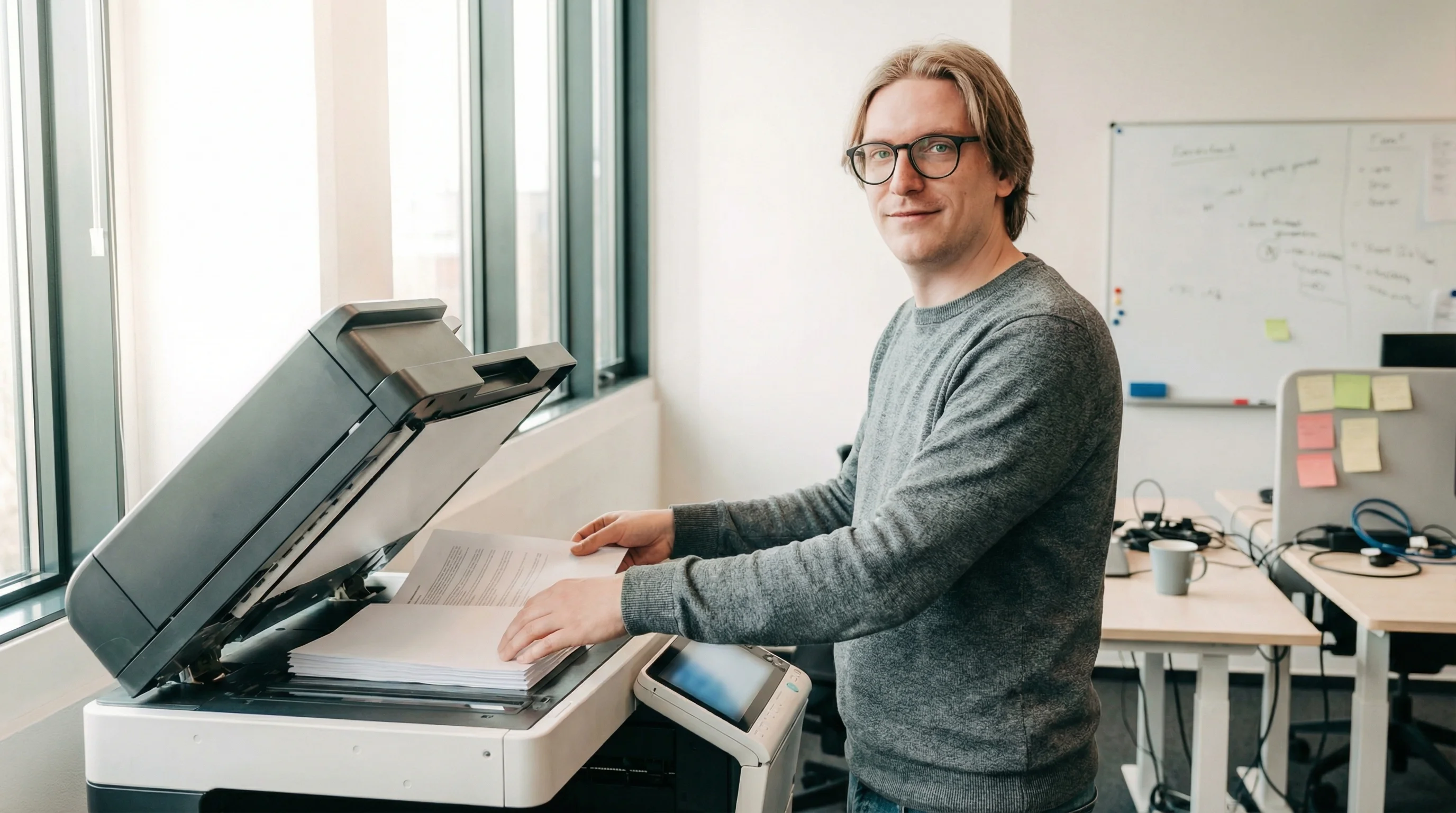
Documents do not write themselves.
The first version does.
Document creation is the same chat on your own data, but in a harness that produces a document instead of an answer. Built from your own material, with the source attached to every passage, so someone can read it over before it goes out.
Why wait?
Smarter flow, fewer errors, more focus on growth.
Automate
Our AI instantly fills templates with data from minutes, CRM or ERP, so HR contracts, compliance reports and notarial deeds are ready in seconds.
Integrate
Plug-and-play connectors for SharePoint, Google Drive, OneDrive and more, zero IT headaches and immediately usable output in familiar formats.
Translate
With a single click we generate consistent documents in any language, perfect for multinational teams or bilingual ISO audits.
Improve
AI scans spelling, tone and branding and automatically adapts the text to your voice, so every document sounds as if you wrote it yourself.

The overview at a glance
A brief overview
We often notice that leaders believe their document processes are unique snowflakes, yet 80% turns out to be repeatable. By adopting AI document automation you hand that 80% over to a system that never gets tired, never drifts and always applies the same quality standard.
Impact in numbers
Accenture reports that companies with AI-driven processes grow 2.5× faster, while KPMG shows that 95% of all fields in order forms can be recognised automatically. This is not future music; it is happening today.
The biggest gain
Fewer fires to put out, more strategic punch. We also frequently see hidden costs, think revision rounds and ad-hoc translation, disappear within three months.
faster throughput, from days to minutes
fewer revision rounds, up to 70%
consistent tone of voice, even across multiple departments
audit-ready archive, real-time and complete
From existing material
to a document that holds up
Six steps. Writing is the fastest one, reading it over stays human work.
-

You start with what you already have
Existing documents supply both the content and the form. How you write things down is already in there.
-

Every passage shows where it came from
That makes a document checkable instead of something to be believed, and you see straight away where an assumption crept in.
-

A person reads it over before it goes out
Always. A document that leaves the building carries your name, not a model.
-

The model and the embedding are a choice
Five embedding providers are available, including models trained specifically on legal texts, on financial documents or on code. You pick one for your whole environment, so the choice at the start counts, and we help you make it.
-

And we measure whether it can be better
We run the same questions past several models and repeat that, so you see which model performs best and which one does so consistently. Quality, speed and token use all come out of the same measurement.
Where the limits sit
What follows belongs in the conversation, not in the small print.
-
A person reads it over
Always. A document that leaves the building carries your name.
-
It does not invent facts that are not there
What is not in your material does not belong in the document. If something is missing, you see it in the source references.
-
One embedding per environment
You pick one for the whole thing, not per knowledge base. If you want a different one later, everything is vectorised again.
-
It is only as good as your data
Messy folders produce messy results. Tidying up is something we do together, and it is usually the bulk of the work.
-
It does not stop, we do
The agent keeps running and can be checked at the weekend too, so you can carry on in your own time. Anything that needs a person on our side waits until the next working day.


Ready to say goodbye to paperwork?
Let's brainstorm about your document flow with no strings attached. We would be happy to devise a safe pilot so you can prove the savings internally straight away.

A philosophical look at paperwork.
Why standard texts can still feel unique.
Documents are stories in disguise; they reveal who you are as an organisation. By embracing AI document automation, people's role shifts from typist to director. The technology removes the repetition, yet creativity and nuance remain one hundred percent human. In fact, because we let go of the repetitive hassle, space emerges for empathy in every contract or policy document. It is therefore not about having fewer people, but about adding more human value per page.
Trust as the common thread
What used to be a "copy-paste culture" evolves into a curation culture. You choose, improve and confirm, instead of typing until your fingers tingle.

A critical look at AI document automation.
Not everything that is smart is also wise.
AI is brilliant at recognising patterns, but context remains crucial. A privacy clause may be mandatory in one sector and overkill in another. We therefore integrate sector rules (think ISO 27001, IFRS or notarial guidelines) into the model, so no generic legal clutter arises. In practice we often see organisations start with invoices and HR letters, only then moving on to the more complex compliance documents. This phased approach minimises risk and maximises support.
Human-in-the-loop remains essential
Automation is never a black box. Every component is explainable, so auditors, CISOs and the Board fully understand why the AI does what it does.

Looking ahead: the internal AI chatbot.
Documents are now conversation partners.
Imagine: a new employee asks in Teams "What about our parental leave?". The chatbot immediately retrieves the most recent HR policy, cites the correct paragraph and offers a personalised form. Within a single conversation the question is answered and the administrative step is taken. This contextual intelligence stems from the same engine as our document automation. So expansion requires no extra infrastructure, just an API key and solid governance.
Continuous learning from questions
Every interaction feeds the model, so policies are refined faster and tacit knowledge becomes visible. The organisation grows smarter, not just bigger.

"A deal is a deal"
Yield.inc is a new asset manager in the Netherlands that focuses on excellent customer experience, sustainability and technology. When faced with the question of whether to develop our platform in-house or with a partner, we got in touch with Spartner. We are still 100% behind the choice for Spartner because we own the source code and with Spartner, a deal really is a deal, whether it concerns the delivery date or the agreed budget!
Hans Lugtenberg Partner at Yield Inc.

"A professional software partner since 2010"
Spartner is involved and contributes in our search for innovations and always delivers top-notch work. After the first Huurda.nl version got out-dated, we collaboratively launched a completely new version in 2020.
Custom-built search engine for rental propertiesNorbert Wegter Owner of 123wonen and Expat Homes Holland

"Pragmatic and flexible collaboration"
Spartner has created a customized portal for us for the accountability of large-scale collaborative projects. This enables us and our partners to execute and account for their plans in a shared environment that is secure, transparent, and manageable. The pragmatic and flexible collaboration with Spartner has ensured that we have quickly achieved a functional and user-friendly environment.
Jurjen Terpstra Managing Partner at Wecreate Consulting

"AI and machine learning as legal tools"
In 2020, we transferred the development of Lynn to Spartner. As a result of their fast development process, the Lynn platform achieves an increasingly central role in the legal world.
Lynn, the smart AI legal robotMarco Caspers Software Development Manager at Lynn Legal

"As a business you must dare to move forward"
Innovation and change are not always welcomed with equal enthusiasm by our employees, man is a creature of habit but as a company you have to dare to move forward and the need for a contemporary drawing program for the realization of various constructions with our Masterbloc bricks was high. For us but also for Spartner, this challenge was a bit of pioneering and together we had to overcome some hurdles to arrive at a beautiful and efficient business tool. A development and learning process for both parties, in which the feedback of questions and desired adjustments by our employees to Spartner was always in good consultation and we could count on quick feedback and targeted solutions. We continue to exchange experiences with Spartner and look back and forward to a successful collaboration.
Powerful 3D construction drawing softwareBjorn Gubbels Owner of Masterbloc

"Spartner extends our capabilities and development capacity"
With weekly calls, using our Azure DevOps sprint system, Spartner actively works together with our innovation, communication and software development departments.
Multi-website CMS with Statamic 3Marco Leenders Head of Automation

"Have been using Laravel Excel for years"
We requested custom help to a performance challenge we had in our implementation of Laravel Excel. I was amazed how quickly these Laravel artisans achieved significant performance gains, which saved us a lot of development time.
Open source package for LaravelJosh Mountain Co-Founder at IncentivePilot.com

"Higher occupancy rate thanks to our user-friendly platform"
Throughout the great years that we cooperate with Spartner (previously Maatwebsite, Ed.), our software has been developed continuously. Students and landlords actively work with features like allocation, payments, chat, contract generation and more.
Custom built ERP for all student residencesMaurice Evers Head of Student Housing Department
"Innovating in the digital identification network of The Netherlands and Europe"
The pro-active approach of Spartner was crucial in understanding the complexity of the eHerkenning network.
Development of eHerkenning connection and servicesMaarten Bremer CTO / Founder Ensured

"Innovation in legal technology"
As jurists with knowledge of IT, we highly value quality; within code, but also in process. The high work-level and trustworthiness of Spartner gives us the capacity to continuously create innovative features.
Legal tech platformNiels Winters Managing Director JuriBlox
How fast can we go live?
On average a basic set-up is live within a few weeks, because the connectors for SharePoint or Google Drive are plug-and-play. Complex workflows naturally need a bit more fine-tuning, but it is still surprisingly quick.
Will the AI match our tone of voice?
Yes, we train on your existing content. As a result, a property deed sounds just as formal as always, while an internal newsletter remains informal. The system learns, fine-tunes and continuously monitors itself.
Is our data safe in the cloud?
Yes. Hosting runs in European data centres and data stays within the EU; any ISO 27001 certification there is held by the data centre operator, not by Spartner. We mask personal data before it reaches an AI model and record every step in an audit trail. You can also opt for on-premise or private cloud if compliance demands it.
What if the AI makes a mistake?
You always remain ultimately responsible. That is why there is a human-in-the-loop step with clear diffusion reports, so you can see exactly which passages were generated automatically.
Does it also work with complex contracts?
Certainly. The system really shines with notarial deeds and ISO documents, because structure and standard clauses already form recognisable patterns.
Do we need to rewrite all our templates now?
No. Spartner Mind accepts Word, Google Docs, Markdown and even old PDF forms. The AI automatically turns them into reusable components.
Can I feed it one language and get ten back?
Exactly. Multilingual output is available as standard, including checks on fixed terminology per market or jurisdiction.
What about licence costs when we scale up?
We use a consumption-based model. You pay for documents actually processed, not for dormant seats. Transparent, with no nasty surprises along the way.