
Internal chatbot.
Work smarter in minutes.
Policy documents in SharePoint, manuals in the wiki, project data scattered across ten folders. Staff lose valuable hours searching. With an internal chatbot on  Spartner MIND, you securely connect all those sources. Colleagues simply ask a question and receive a substantiated answer with source references. Fewer errors, full control over your data.
Knowledge at your fingertips with #MIND
Never leaf through folders or wikis again
Automate
The platform searches hundreds of policy documents, proposals and manuals in seconds. No more manual trawling, just an immediate answer with source reference.
Integrate
Secure connections to SharePoint, Confluence, CRMs and legacy systems. Existing roles and permissions stay intact; data never leaves the EU.
Validate
Every answer includes source references. Via the Audit Trail you see exactly which documents were consulted and how the answer was formed. No black box.
Improve
The Skill Builder lets you refine answers based on feedback. You build a reusable knowledge library that grows with your organisation.

Always the right answer, with sources attached.
An internal chatbot is more than a search bar. The platform combines your documents with business logic, so employees find not just information but actionable answers.
Less searching, more doing
Employees type their question and immediately receive a usable answer with source reference. No more interrupted workflows to look something up in SharePoint or the wiki.
Confidence through transparency
Because every answer is traceable via the Audit Trail, teams act more confidently. They see exactly which sources were used and can verify when in doubt.
Compliance without extra effort
The chatbot quotes current legislation and internal guidelines. All data stays within the EU, and you retain full control over access rights per user or team.
Colleagues get answers immediately instead of searching themselves.
Error rates fall by an average of 35%.
Onboarding time shortens by one to two weeks.
Implementation roadmap for an internal chatbot.
An overview of the crucial steps—from source inventory to continuous tuning.


Step 1 — Inventory sources.
We start with a deep-dive workshop: which intranet pages, PDF manuals and shared drives contain critical knowledge? Less is sometimes more; duplicate files are removed immediately.
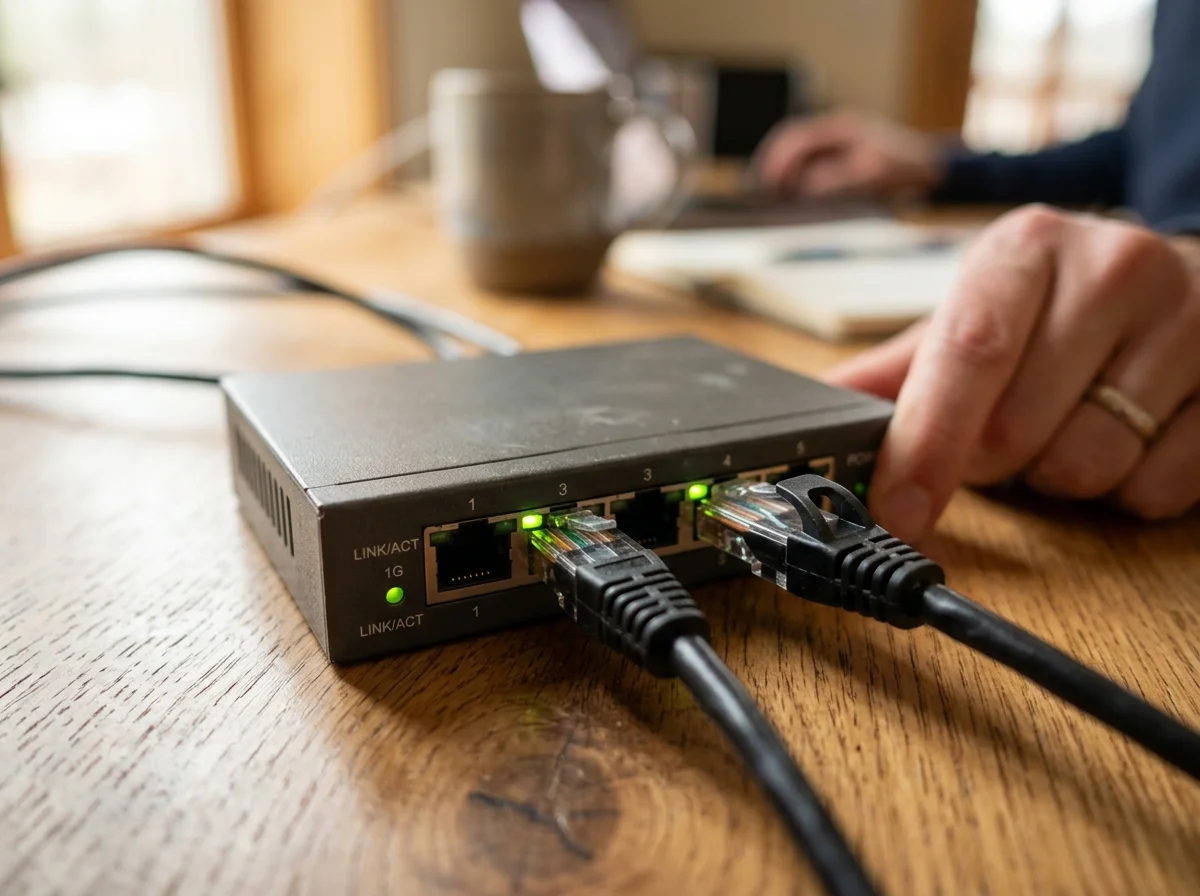

Step 2 — Set up a secure connection.
OAuth, service accounts, data classification—it might sound dull, but this layer determines whether the rest will succeed. Security therefore always comes first.


Step 3 — Training round.
The bot learns from the selected documents. We label data, set context boundaries and test response time versus accuracy.


Step 4 — Pilot with power users.
A small group of experienced users asks tricky—and sometimes oddly phrased—questions. Their feedback fine-tunes the flows and prevents teething problems.


Step 5 — Roll-out and continuous tuning.
After go-live we measure question patterns, fill gaps and release versions with improved intent detection or fresh integrations such as voice.


Ready to put knowledge to work?
Let us explore together which internal sources your teams have yet to tap. A no-strings conversation—coffee included—offers immediate clarity on feasibility, security requirements and the first quick wins.

A critical look at hype and reality
Chatbots are no magic wand, but they are a lever
We notice that organisations sometimes expect a chatbot to fix every outdated process. That is difficult when the underlying data is messy. In fact, a bot amplifies inconsistencies when sources contradict one another. Data quality therefore deserves priority above all else.
Context is king
Without clear usage guidelines the bot will guess. And guessing on compliance questions? Best avoided.
Setting boundaries
We limit the language model to internal context so nobody is confronted with public internet material out of the blue.

Getting concrete: five practical tips
Start today without drafting a year-long plan
1. Start small; choose a single department. 2. Select high-volume, low-complexity questions (leave, expenses). 3. Document missed answers, then enrich the dataset. 4. Measure adoption through chat logs, not gut feeling. 5. Integrate into the existing chat client, for example Teams.

Looking ahead to the future
From text to multimodal assistance
Within two years we expect speech-driven internal chatbots that generate presentations from raw project data. We are already seeing pilots where augmented-reality glasses project the bot’s answers above factory machines—handy, but still pricey.
Self-learning compliance
Legislation changes; the next generation of bots will automatically monitor official journals and update policy texts in real time.

"A deal is a deal"
Yield.inc is a new asset manager in the Netherlands that focuses on excellent customer experience, sustainability and technology. When faced with the question of whether to develop our platform in-house or with a partner, we got in touch with Spartner. We are still 100% behind the choice for Spartner because we own the source code and with Spartner, a deal really is a deal, whether it concerns the delivery date or the agreed budget!
Hans Lugtenberg Partner at Yield Inc.

"A professional software partner since 2010"
Spartner is involved and contributes in our search for innovations and always delivers top-notch work. After the first Huurda.nl version got out-dated, we collaboratively launched a completely new version in 2020.
Custom-built search engine for rental propertiesNorbert Wegter Owner of 123wonen and Expat Homes Holland

"Pragmatic and flexible collaboration"
Spartner has created a customized portal for us for the accountability of large-scale collaborative projects. This enables us and our partners to execute and account for their plans in a shared environment that is secure, transparent, and manageable. The pragmatic and flexible collaboration with Spartner has ensured that we have quickly achieved a functional and user-friendly environment.
Jurjen Terpstra Managing Partner at Wecreate Consulting

"AI and machine learning as legal tools"
In 2020, we transferred the development of Lynn to Spartner. As a result of their fast development process, the Lynn platform achieves an increasingly central role in the legal world.
Lynn, the smart AI legal robotMarco Caspers Software Development Manager at Lynn Legal

"As a business you must dare to move forward"
Innovation and change are not always welcomed with equal enthusiasm by our employees, man is a creature of habit but as a company you have to dare to move forward and the need for a contemporary drawing program for the realization of various constructions with our Masterbloc bricks was high. For us but also for Spartner, this challenge was a bit of pioneering and together we had to overcome some hurdles to arrive at a beautiful and efficient business tool. A development and learning process for both parties, in which the feedback of questions and desired adjustments by our employees to Spartner was always in good consultation and we could count on quick feedback and targeted solutions. We continue to exchange experiences with Spartner and look back and forward to a successful collaboration.
Powerful 3D construction drawing softwareBjorn Gubbels Owner of Masterbloc

"Spartner extends our capabilities and development capacity"
With weekly calls, using our Azure DevOps sprint system, Spartner actively works together with our innovation, communication and software development departments.
Multi-website CMS with Statamic 3Marco Leenders Head of Automation

"Have been using Laravel Excel for years"
We requested custom help to a performance challenge we had in our implementation of Laravel Excel. I was amazed how quickly these Laravel artisans achieved significant performance gains, which saved us a lot of development time.
Open source package for LaravelJosh Mountain Co-Founder at IncentivePilot.com

"Higher occupancy rate thanks to our user-friendly platform"
Throughout the great years that we cooperate with Spartner (previously Maatwebsite, Ed.), our software has been developed continuously. Students and landlords actively work with features like allocation, payments, chat, contract generation and more.
Custom built ERP for all student residencesMaurice Evers Head of Student Housing Department
"Innovating in the digital identification network of The Netherlands and Europe"
The pro-active approach of Spartner was crucial in understanding the complexity of the eHerkenning network.
Development of eHerkenning connection and servicesMaarten Bremer CTO / Founder Ensured
.webp)
"Innovation in legal technology"
As jurists with knowledge of IT, we highly value quality; within code, but also in process. The high work-level and trustworthiness of Spartner gives us the capacity to continuously create innovative features.
Legal tech platformNiels Winters Managing Director JuriBlox
Frequently asked questions
Practical answers to the questions we hear most often.
😊 What exactly is an internal chatbot?
An internal chatbot is an AI-driven conversational partner that answers employees’ questions based on internal documents such as policy papers, proposals, project reports or legislation. Instead of searching yourself, you simply ask a question in natural language.
🤔 How does the bot safeguard sensitive data?
We connect via encrypted APIs, apply strict access rights and log every interaction. In addition, the language model remains in a closed environment; no data are sent to external cloud services without explicit permission.
🚀 How quickly will we see results?
Although exact timing varies per organisation, most notice within a few weeks that repetitive questions are handled more quickly. The immediate saving lies mainly in fewer search hours and a reduction in human errors.
📚 Which document types can the bot process?
PDFs, Word files, wiki pages, spreadsheets and even structured data from CRM systems. As long as it contains machine-readable text, it can in principle be indexed.
💰 Is it expensive to get started?
Costs depend on the number of connections and complexity. A small-scale pilot usually fits within a limited budget. More importantly: you immediately start building a Skills library that you keep using.
😅 What if the bot gives a wrong answer?
Human validation remains essential. We build feedback buttons so users can immediately indicate when an answer is incorrect. That feedback enters a retraining cycle so the error does not repeat itself.
😎 Can the bot handle multiple languages as well?
Yes, multilingual models are possible. Bear in mind, however, that the source documents must also be multilingual; otherwise, a knowledge gap will still arise.
🔧 What is required on the IT side?
A modern identity provider (Azure AD, Okta), API access to data sources and ideally a dev environment for testing. We also review network architecture to minimise latency and security risks.
🌱 How scalable is the system?
Thanks to container technology (Docker, Kubernetes) you can scale as usage grows. Adding compute nodes horizontally is usually enough to handle peaks.
🏆 Why choose Spartner over other providers?
We combine AI expertise with knowledge of business processes. All data stays within European data centres. And you get no black box: via the Audit Trail you see exactly what happens.