Smarter software
in Amsterdam.
Companies in the capital are not looking for yet another generic solution; they need software development in Amsterdam that truly adds value. Spartner combines deep AI expertise with years of hands-on experience in bespoke software development in Amsterdam, enabling organisations to innovate faster, simplify processes and attract talent. What we notice is that the bar is particularly high here: users expect flawless performance as well as a touch of wow factor. We deliver exactly that, time and again.
So why Spartner?
From idea to impact, without detours
Automate
Spartner builds AI-driven workflows that remove tedious tasks, allowing canal-belt teams to work up to 38% faster.
Integrate
We connect new modules seamlessly with existing ERP and CRM systems—no prolonged brown-outs, just plug-and-play, plain and simple.
Innovate
By constantly experimenting with generative AI, AR overlays and voice interfaces, your platform stays fresh and future-proof.
Scale
Every algorithm is cloud-native, so peak loads during, for instance, ADE or Black Friday are absorbed effortlessly.

A software journey is a bit like sailing across the IJ.
A software journey is a bit like sailing across the IJ. Sometimes the water is like a mirror, sometimes a sudden gust of wind changes your course.
But always with a clear compass.
The result is software development in Amsterdam that delivers value early on instead of landing six months later.
User stories are prioritised based on data, not hierarchy
AI models are first trained on safely anonymised datasets
Feedback loops are short: stakeholders see something tangible every sprint
A typo here and there is human; quality remains paramount
Our proven approach.
Four steps take your idea from discovery to scalable reality.


Step 1 – Discover.
We kick off with a two-day pressure-cooker session in the heart of Amsterdam-Noord. All stakeholders, one whiteboard and a stack of Post-its. We dissect the challenge, challenge assumptions and unveil growth opportunities. Incidentally, this is where the phrase “software for development and coaching Amsterdam” often pops up, because many teams want to embed a learning culture in their tooling.
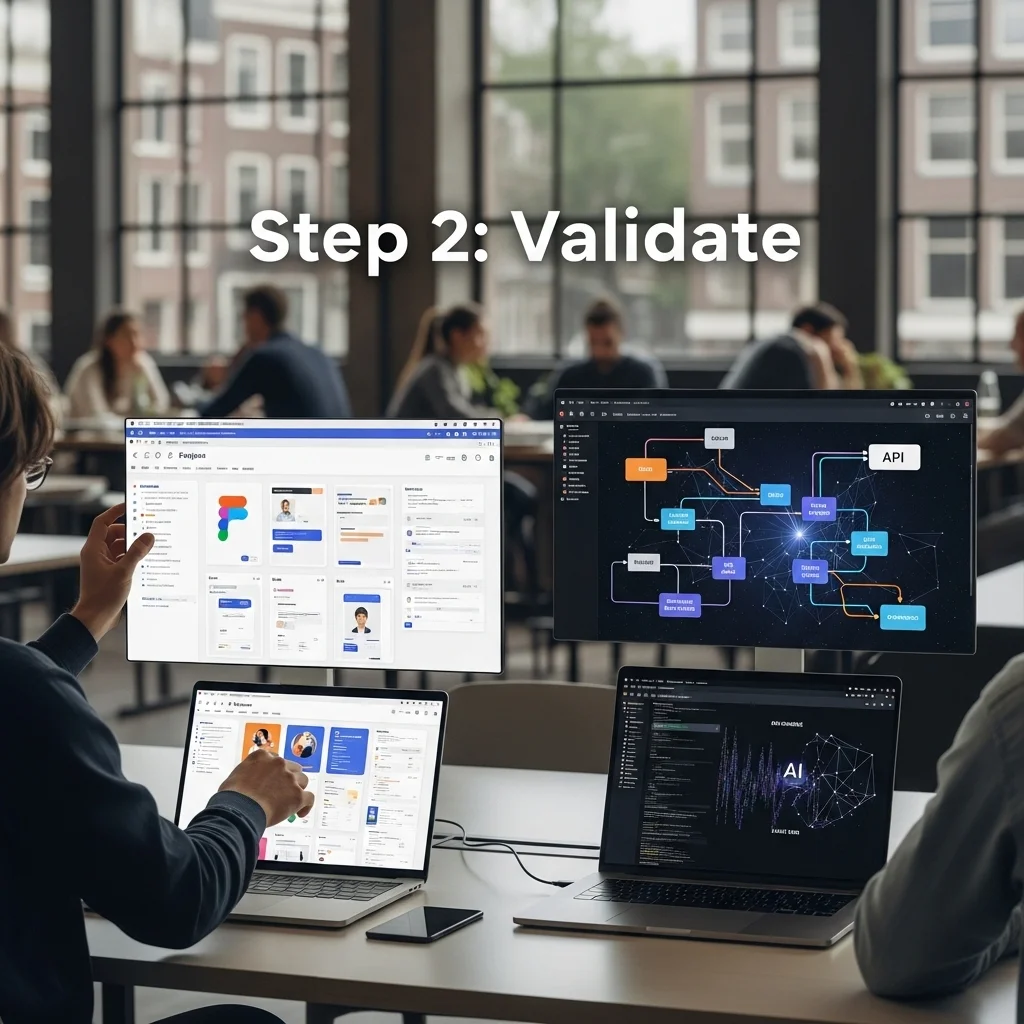

Step 2 – Validate.
Prototypes fly around in Figma, API paths are mapped out and a proof-of-concept AI model is already running on test data. So before a single line of production code is written, we measure whether the idea can take off in the market.


Step 3 – Realise.
This is where the real code comes to life. And let’s be honest, we write a lot of it. Microservices in Go, event streams in Kafka, front-ends in React Native—it all depends on your context. In practice we often see that bespoke software development in Amsterdam raises questions such as “does this fit within our compliance frameworks?” The answer is yes, because we embed ISO standards from day one.


Step 4 – Learn & Scale.
After launch the best part begins: optimising based on real-time insights. AI models are retrained, we plug in new data sources without downtime and coaching modules help teams sharpen their skills further. This way, software development in Amsterdam never stands still but evolves with the city that never sleeps.


Ready to spar about your digital ambitions?
Just pick up the phone or send a message. We are happy to enjoy a coffee (or yerba mate) in the Jordaan to explore how software for development and coaching in Amsterdam can accelerate your organisation. No slides, just concrete ideas.

A critical look at AI hype.
From buzzword to business value.
Everyone these days claims AI is the solution to everything, yet they often forget the maintenance. Models age, biases creep in and performance degrades. As mentioned earlier, Spartner is all about continuous learning. That is why we schedule monthly retraining cycles and monitor drift with automatic alerting. The result? Bespoke software development in Amsterdam that remains reliable under real-world conditions.
Transparency as a prerequisite.
We log feature inputs, explain outcomes and give stakeholders insight into the decision trees. Not sexy, but necessary.
Practical tips for CTOs in the capital.
Avoid the six pitfalls of rapid growth.
Excessive feature-driven frenzy, overly complex architecture, inadequate test coverage, vendor lock-in, underestimated security and vague governance—you know the drill. If you want to escape them, start small with a modular foundation. It sounds simple, yet software development in Amsterdam shows that modularity is the key.
Concrete actions.
Create a clear backlog, automate CI/CD from sprint one and involve end users weekly. Done.


Looking ahead: the role of generative AI in 2026.
From chatbots to co-creators.
In fact, generative AI is moving from simple conversation to a full-fledged partner in product design. Expect code suggestions, test scenarios and UX mock-ups to emerge automatically. In Amsterdam we already see pilots where designers give prompts and iterations adjust live. Spartner is investing heavily in this tooling so that software development in Amsterdam shifts up a gear.
Ethics remains paramount.
Bias detection, explainability and inclusive datasets receive structural budget, not just a “nice to have”.

"A deal is a deal"
Yield.inc is a new asset manager in the Netherlands that focuses on excellent customer experience, sustainability and technology. When faced with the question of whether to develop our platform in-house or with a partner, we got in touch with Spartner. We are still 100% behind the choice for Spartner because we own the source code and with Spartner, a deal really is a deal, whether it concerns the delivery date or the agreed budget!
Hans Lugtenberg Partner at Yield Inc.

"A professional software partner since 2010"
Spartner is involved and contributes in our search for innovations and always delivers top-notch work. After the first Huurda.nl version got out-dated, we collaboratively launched a completely new version in 2020.
Custom-built search engine for rental propertiesNorbert Wegter Owner of 123wonen and Expat Homes Holland

"Pragmatic and flexible collaboration"
Spartner has created a customized portal for us for the accountability of large-scale collaborative projects. This enables us and our partners to execute and account for their plans in a shared environment that is secure, transparent, and manageable. The pragmatic and flexible collaboration with Spartner has ensured that we have quickly achieved a functional and user-friendly environment.
Jurjen Terpstra Managing Partner at Wecreate Consulting

"AI and machine learning as legal tools"
In 2020, we transferred the development of Lynn to Spartner. As a result of their fast development process, the Lynn platform achieves an increasingly central role in the legal world.
Lynn, the smart AI legal robotMarco Caspers Software Development Manager at Lynn Legal

"As a business you must dare to move forward"
Innovation and change are not always welcomed with equal enthusiasm by our employees, man is a creature of habit but as a company you have to dare to move forward and the need for a contemporary drawing program for the realization of various constructions with our Masterbloc bricks was high. For us but also for Spartner, this challenge was a bit of pioneering and together we had to overcome some hurdles to arrive at a beautiful and efficient business tool. A development and learning process for both parties, in which the feedback of questions and desired adjustments by our employees to Spartner was always in good consultation and we could count on quick feedback and targeted solutions. We continue to exchange experiences with Spartner and look back and forward to a successful collaboration.
Powerful 3D construction drawing softwareBjorn Gubbels Owner of Masterbloc

"Spartner extends our capabilities and development capacity"
With weekly calls, using our Azure DevOps sprint system, Spartner actively works together with our innovation, communication and software development departments.
Multi-website CMS with Statamic 3Marco Leenders Head of Automation

"Have been using Laravel Excel for years"
We requested custom help to a performance challenge we had in our implementation of Laravel Excel. I was amazed how quickly these Laravel artisans achieved significant performance gains, which saved us a lot of development time.
Open source package for LaravelJosh Mountain Co-Founder at IncentivePilot.com

"Higher occupancy rate thanks to our user-friendly platform"
Throughout the great years that we cooperate with Spartner (previously Maatwebsite, Ed.), our software has been developed continuously. Students and landlords actively work with features like allocation, payments, chat, contract generation and more.
Custom built ERP for all student residencesMaurice Evers Head of Student Housing Department

"Innovating in the digital identification network of The Netherlands and Europe"
The pro-active approach of Spartner was crucial in understanding the complexity of the eHerkenning network.
Development of eHerkenning connection and servicesMaarten Bremer CTO / Founder Ensured
.webp)
"Innovation in legal technology"
As jurists with knowledge of IT, we highly value quality; within code, but also in process. The high work-level and trustworthiness of Spartner gives us the capacity to continuously create innovative features.
Legal tech platformNiels Winters Managing Director JuriBlox
Why do so many companies choose software development in Amsterdam? 🤔
Amsterdam combines an international talent pool with a compact infrastructure. You will find fintech, healthtech and creative agencies all within cycling distance. That mix creates rapid cross-pollination, something software projects benefit from.
What makes Spartner different from other agencies in the city? 🌱
We bring AI expertise, product coaching and cloud skills together in one multidisciplinary team. This means you do not get three suppliers but one partner who takes end-to-end responsibility.
Can bespoke really be faster than off-the-shelf packages? ⚡
Yes. By combining reusable components with smart automation we often deliver sooner than expected. After all, you also have to configure and adapt a generic tool.
How do you guarantee security in AI projects? 🔒
All pipelines run in containerised environments, secrets stay in Vault and we log access at record level. Passive? No, we also run active penetration tests every quarter.
Does "software for development and coaching Amsterdam" also suit smaller organisations? 🛠️
Absolutely. The coaching modules are modular. A start-up can begin with one skill set and expand later without rebuilding.
Do you only work in Amsterdam? 🚴
Head office is in Utrecht, but our developers spend four days a week in Amsterdam. So yes, practically speaking we do.
Do you also support legacy migrations? 💾
Certainly, although we prefer to call it "modernisation". We isolate old systems via API facades and migrate step by step, so the business keeps running.
Roughly what does it cost? 💶
We understand budget matters, but prices depend on scope and complexity. Let's have coffee first and define the challenge.
How quickly can a project go live? ⏱️
Sometimes within ten weeks, sometimes longer. It depends on available data, internal resources and compliance requirements.
Is AI just a hype? 🤖
Parts of it are, to be honest, but the core is valuable. Seeing through the hype is exactly what we do: we apply it where it works and skip it where it’s just noise.