
Cloud hosting,
tailored to what you need.
Cloud hosting should fit like a tailored suit, not the other way around. That is why Spartner helps you choose and implement: Azure, Google Cloud, AWS, or a European option such as TransIP or Hetzner. We are vendor-neutral, build modern CI/CD pipelines from repository to environment, and run your applications smoothly on Kubernetes or Docker. From a single VPS to a redundant cluster with load balancing.
Choose vendor-neutral
You do not have to choose on gut feel. We validate your ambitions, architecture and compliance requirements, and let the facts speak: workloads get the cloud that fits functionally, financially and operationally.
Automate
Without a solid pipeline, cloud work is only half done. We set up CI/CD (e.g. GitHub Actions, GitLab CI), automate deployments with Terraform and Ansible, and package services in containers. Result: less manual work, fewer errors, faster releases. Exactly what teams want.
Integrate
Cloud does not stand alone; it connects to your existing tooling and data. Think secret management, logging, monitoring and identity. We connect your code, data and platform in a way that stays repeatable and auditable (your compliance officer will appreciate it).
Scale
Small today, busy tomorrow. With autoscaling, horizontal pods and smart resource management you get room to grow without friction. For web, API or data workloads (batch or real-time) we design scaling paths that avoid replatforming while keeping performance predictable.
Secure
Security by design. From network segmentation and WAF to image scanning and policy-as-code (OPA). And yes, that goes beyond a single firewall rule. We build a foundation that fits zero-trust, with strong defaults and day-to-day practice in mind: human, measurable, abuse-resistant.

What you do want
In practice, teams often accelerate once they move from manual deployments to an automated pipeline. The flow changes: push code, run tests, build the container, roll out automatically. Done. The biggest gain is not technology but predictability. Releases become routine, not an event.
What you do not want
Vendor lock-in without a clear reason. A cluster only one engineer knows inside out. Or a logging landscape where you can only find what happened after an incident. That is why we build documentation alongside code, codify infra (IaC), and make observability part of your platform, not a separate tool.


What Spartner stands for
We are vendor-neutral. So we look beyond the one-size-fits-all rollout. Your workload may run perfectly on Azure or AWS, but sometimes a Dutch provider such as TransIP or a European player such as Hetzner is smarter. Latency, data location and cost profile matter too. As I said earlier: the right cloud, not the biggest.
For development teams: fast pipelines, clear environments, less manual work.
For operations: repeatable infra, monitoring-first, tight operations.
For the business: agility, risk control, choices with a clear rationale.
For the future: a cloud-native foundation (Kubernetes/Docker) that scales with you.
How do you navigate this B2B reality?
Theory is interesting, but value comes from putting it into practice. Here is a step-by-step approach to implement these insights without drowning in complexity from day one.


Step 1: clarify goals and constraints.
We start with your goals: availability, scalability, compliance, budget and time-to-value. We map application architecture (monolith, microservices, event-driven) and identify critical workloads. We also look at data location (EU/US), identity and integrations. It sounds formal, but it prevents surprises later—and surprises are what you want to avoid in production.


Step 2: architecture and platform choice.
Next we make a short, sharp comparison: Azure, Google Cloud or AWS? Or does a European/Dutch platform (TransIP, Hetzner) fit better for latency, data protection and cost? We sketch reference architectures: from managed Kubernetes (AKS, GKE, EKS) to a lean cluster on VPSes with load balancing. Critically: we do not pick the prettiest brochure—we pick the best fit-for-purpose design.


Step 3: pipelines and infrastructure as code.
No pipeline means no cloud rhythm. So we set up CI/CD (e.g. GitHub Actions, GitLab CI or Azure DevOps), wire in secret management safely and template deployments. Infrastructure as code with Terraform (network, compute, databases) and configuration with Ansible or Helm. You feel the effect immediately: consistent rollouts from dev to test to production—without “works on my machine”.
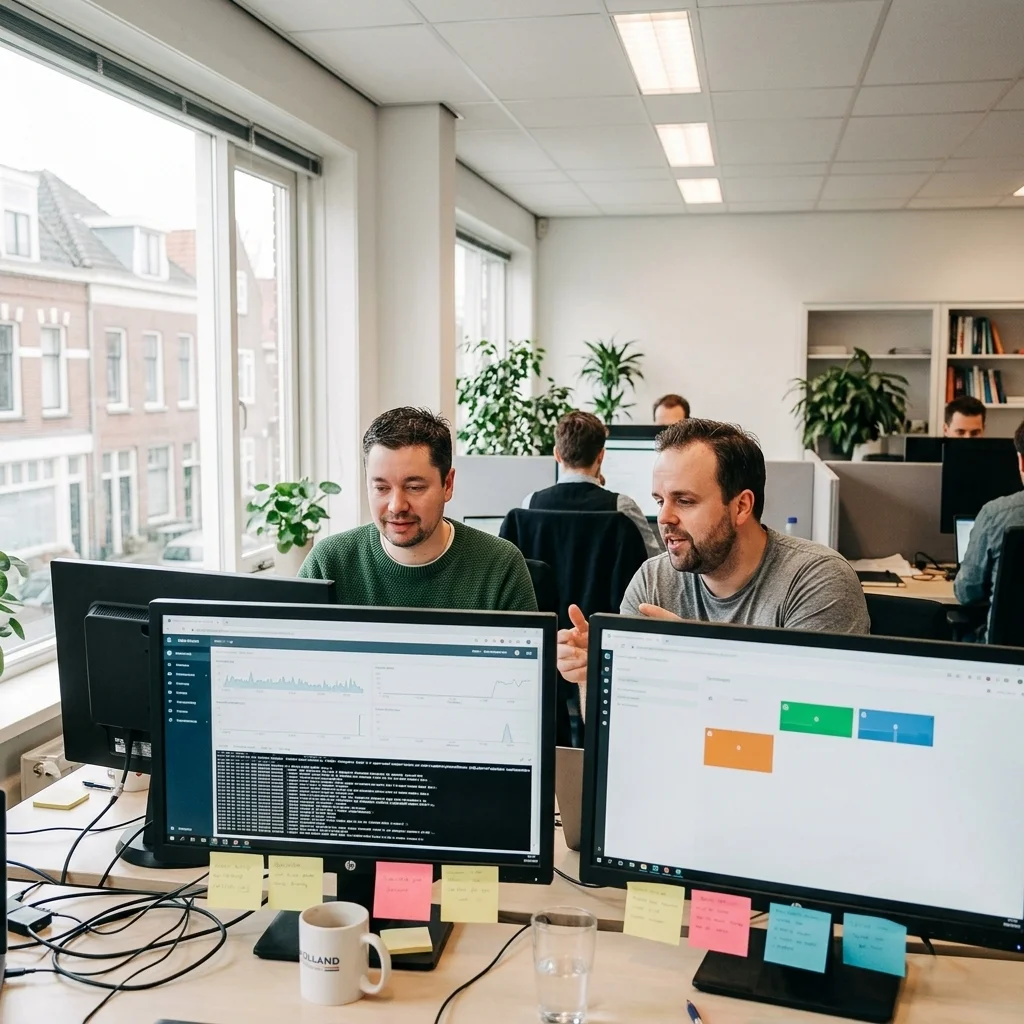

Step 4: container platform, observability and security.
We deploy Kubernetes or Docker Swarm with clear namespaces, resource quotas and autoscaling. Observability is default: metrics, logging, tracing, preferably central and searchable. Security is not an afterthought: image scans, policy-as-code (OPA/Gatekeeper), network policies and identity federation.
Release strategy (blue/green, canary).
Backups and restore tests (yes, we actually test them).
Configurable load balancing and failover.
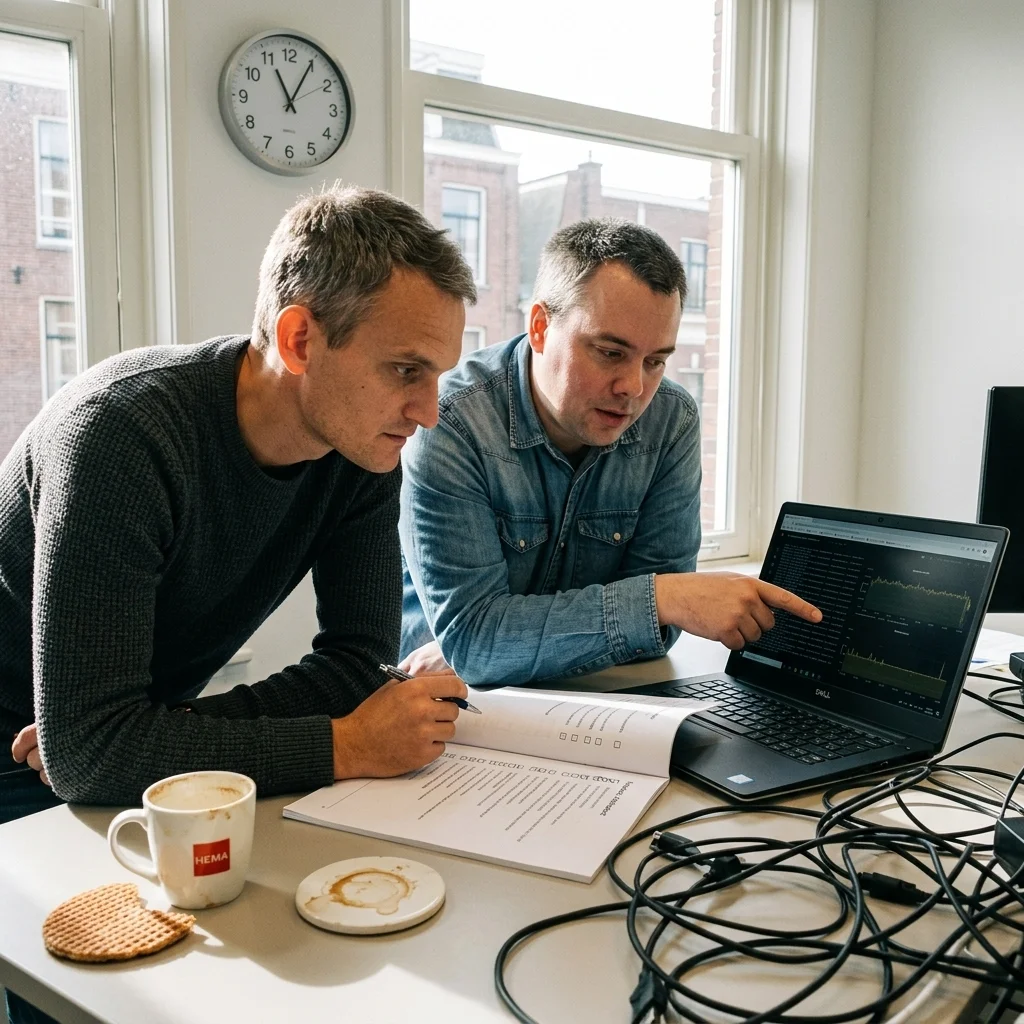

Step 5: operations, fine-tuning and continuous improvement.
After go-live is when it really starts. We fine-tune resources, tackle performance hotspots and organise runbooks for incidents. Release cadence stays healthy and monitoring gets richer (more signal, less noise). If you consider extra regions or multi-cloud, we design that as an extension path—not as unnecessary complexity for tomorrow.


Step 6: governance and knowledge transfer.
Technology is half the story; people are the other half. We secure knowledge: documentation, short sessions with your team and clear ownership. Governance also means we do not only install tooling—we help teams learn to use it. Because you do not want to depend on the one expert who “set it up once”.


Want to talk through your cloud path?
Have us take a look. No hard sell—just an honest conversation about your workloads, ambitions and hurdles. Sometimes one concrete suggestion is enough to move forward; sometimes we build a solid foundation together. You set the pace; we share our craft and experience.

A critical look at cloud choices
Not every workload has the same needs—so why would you apply the same solution everywhere?
Cloud hosting is not a goal in itself. It is a way to develop faster, run more reliably and scale smarter. But if you are not careful, it becomes a pile of services without coherence. What stands out: the best platforms are boringly stable and predictable, not flashy.
Avoid blind trust in defaults
Default settings are a starting point, not the finish line. Think network policies, identity, secrets and resource limits. Defaults are often too permissive or too generous. We put down opinionated baselines with clear choices so security and performance are intentional—not accidental.
Data location and regulation are real requirements
The gap between an EU provider and a global hyperscaler can be large, especially around data jurisdiction and auditability. If your organisation has strict privacy needs, a provider such as TransIP or Hetzner can give exactly the certainty that keeps the rest of your platform calm.
Multi-cloud—with a reason
Multi-cloud sounds impressive. It is not always needed. Do it when it adds value: geo-redundancy, specific managed services or cost optimisation. Design it with declarative infra and portable workloads (containers, open standards). That avoids integration pain.

Very practical: tips you can apply immediately
Small improvements in your pipeline and platform buy disproportionate calm and speed.
Pipeline hygiene
Build, test and scan every commit; never push unscanned images.
Separate build and deploy credentials; use short-lived tokens.
Make your pipeline idempotent and repeatable (no “click ops” steps).
Document your release lever: blue/green or canary—but choose.
Infrastructure as code, but readable
Use Terraform modules with clear variables; avoid copy-paste stacks.
Keep environments (dev/test/prod) consistent and parameterise differences.
Store state safely, with locking and backups.
Make policy-as-code part of your plan (e.g. OPA).
Kubernetes essentials
Start with resource limits/requests, HPA and readiness/liveness probes.
Use namespaces per team or domain, with quotas.
Encrypt secrets and restrict access with RBAC.
Centralise logs and metrics; discuss alerts in stand-ups (sounds dull, works).
Security without friction
Integrate image scanning into your build (Trivy/Grype).
Harden base images; update often.
Use default-deny network policies and open only what you need.
Automate TLS rotation; nobody likes expiring certificates.
Backups you can trust
Write restore runbooks and test them.
Store off-site copies (object storage) with immutability.
Set RPO/RTO realistically; plain language helps teams stay focused.
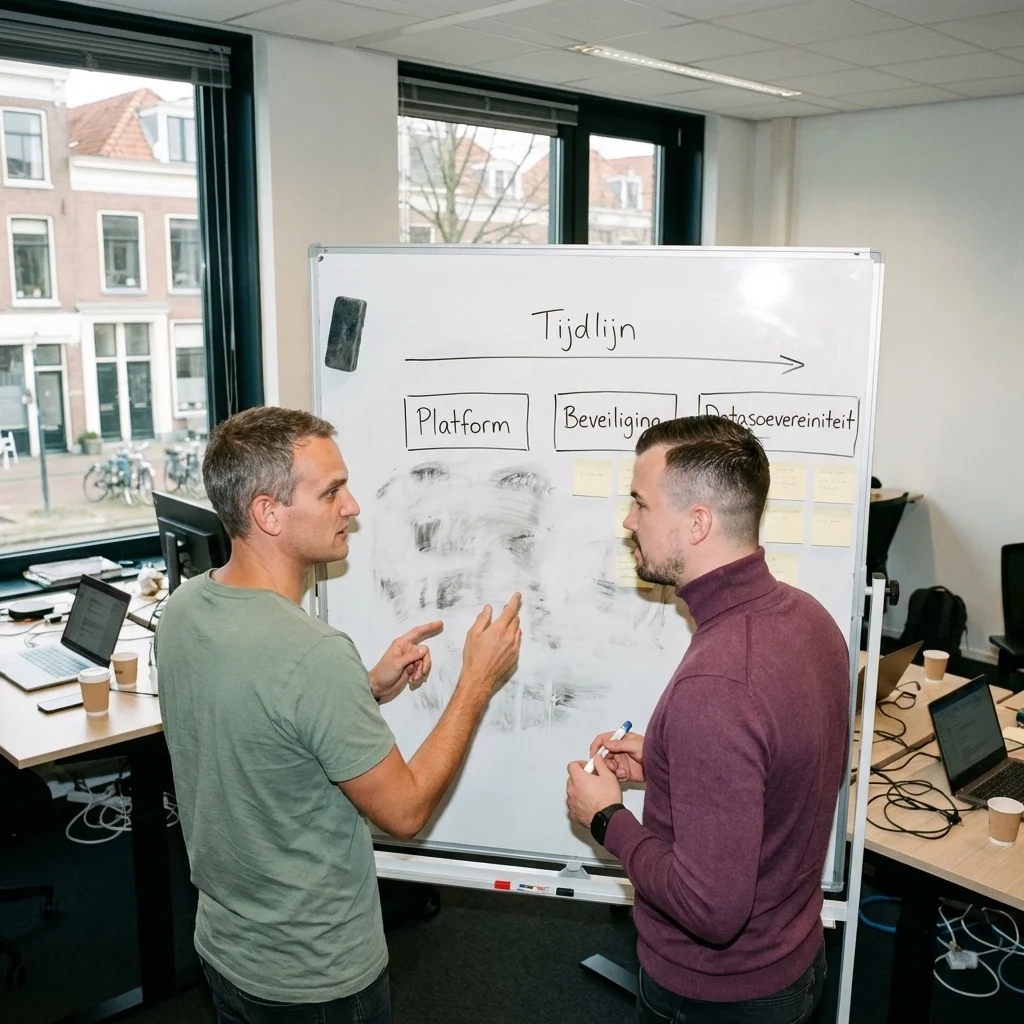
Outlook: where cloud hosting is heading
Containers are here to stay, but the focus shifts to platform experience, security and sovereignty.
Platform engineering for developer happiness
Self-service platforms (with golden paths) make teams faster without losing freedom. Think templates for new services, standard observability and an internal developer portal. That reduces variation in “how” and puts more focus on “what” you build.
Serverless and containers—not either/or
For event-driven functions, serverless is excellent; for stateful or performance-sensitive workloads, containers remain strong. It becomes a both-and story: pick the best runtime model per feature and stay cost-sharp by minimising idle time.
European digital sovereignty
More organisations deliberately choose EU data storage and providers—not out of sentiment, but for risk management and compliance. That makes combinations of hyperscalers and European providers (TransIP, Hetzner) normal: legally clear, technically modern, strategically agile.
Security shift-left—with context
Security moves into the pipeline. Context matters more: prioritise risks by real impact instead of endless “critical” lists. Policy-as-code, SBOMs and runtime protection form a foundation together—and teams stay sane when it is set up well.

"A deal is a deal"
Yield.inc is a new asset manager in the Netherlands that focuses on excellent customer experience, sustainability and technology. When faced with the question of whether to develop our platform in-house or with a partner, we got in touch with Spartner. We are still 100% behind the choice for Spartner because we own the source code and with Spartner, a deal really is a deal, whether it concerns the delivery date or the agreed budget!
Hans Lugtenberg Partner at Yield Inc.

"A professional software partner since 2010"
Spartner is involved and contributes in our search for innovations and always delivers top-notch work. After the first Huurda.nl version got out-dated, we collaboratively launched a completely new version in 2020.
Custom-built search engine for rental propertiesNorbert Wegter Owner of 123wonen and Expat Homes Holland

"Pragmatic and flexible collaboration"
Spartner has created a customized portal for us for the accountability of large-scale collaborative projects. This enables us and our partners to execute and account for their plans in a shared environment that is secure, transparent, and manageable. The pragmatic and flexible collaboration with Spartner has ensured that we have quickly achieved a functional and user-friendly environment.
Jurjen Terpstra Managing Partner at Wecreate Consulting

"AI and machine learning as legal tools"
In 2020, we transferred the development of Lynn to Spartner. As a result of their fast development process, the Lynn platform achieves an increasingly central role in the legal world.
Lynn, the smart AI legal robotMarco Caspers Software Development Manager at Lynn Legal

"As a business you must dare to move forward"
Innovation and change are not always welcomed with equal enthusiasm by our employees, man is a creature of habit but as a company you have to dare to move forward and the need for a contemporary drawing program for the realization of various constructions with our Masterbloc bricks was high. For us but also for Spartner, this challenge was a bit of pioneering and together we had to overcome some hurdles to arrive at a beautiful and efficient business tool. A development and learning process for both parties, in which the feedback of questions and desired adjustments by our employees to Spartner was always in good consultation and we could count on quick feedback and targeted solutions. We continue to exchange experiences with Spartner and look back and forward to a successful collaboration.
Powerful 3D construction drawing softwareBjorn Gubbels Owner of Masterbloc

"Spartner extends our capabilities and development capacity"
With weekly calls, using our Azure DevOps sprint system, Spartner actively works together with our innovation, communication and software development departments.
Multi-website CMS with Statamic 3Marco Leenders Head of Automation

"Have been using Laravel Excel for years"
We requested custom help to a performance challenge we had in our implementation of Laravel Excel. I was amazed how quickly these Laravel artisans achieved significant performance gains, which saved us a lot of development time.
Open source package for LaravelJosh Mountain Co-Founder at IncentivePilot.com

"Higher occupancy rate thanks to our user-friendly platform"
Throughout the great years that we cooperate with Spartner (previously Maatwebsite, Ed.), our software has been developed continuously. Students and landlords actively work with features like allocation, payments, chat, contract generation and more.
Custom built ERP for all student residencesMaurice Evers Head of Student Housing Department

"Innovating in the digital identification network of The Netherlands and Europe"
The pro-active approach of Spartner was crucial in understanding the complexity of the eHerkenning network.
Development of eHerkenning connection and servicesMaarten Bremer CTO / Founder Ensured
.webp)
"Innovation in legal technology"
As jurists with knowledge of IT, we highly value quality; within code, but also in process. The high work-level and trustworthiness of Spartner gives us the capacity to continuously create innovative features.
Legal tech platformNiels Winters Managing Director JuriBlox
What is the difference between cloud hosting and a VPS?
A VPS is a single virtual server on shared hardware. Cloud hosting ties multiple servers into one cluster and distributes capacity dynamically. That makes it easier to scale, absorb failure and spread workloads. In both cases you can automate and secure, but cloud hosting often offers more flexibility and resilience. 🙂
Which provider should I choose: Azure, Google Cloud, AWS, TransIP or Hetzner?
It depends on your requirements. Hyperscalers offer a broad range of managed services and global coverage. European providers are sometimes ideal for data location, latency and simplicity. We look at workload profile, compliance, integrations and budget and advise the best fit—vendor-neutral. 🚀
Do we need Kubernetes or is Docker enough?
Not everything needs Kubernetes. Small or monolithic apps can run perfectly on Docker (with light orchestration) or even on a single VPS. Once you have multiple services, larger teams or scaling paths, Kubernetes offers clear benefits: declarative management, autoscaling, self-healing and ecosystem tooling. ⚙️
What about data in Europe—does it really matter?
For many organisations, yes. Data location determines which laws apply, with impact on privacy, compliance and audits. Choosing EU locations or Dutch data centres (e.g. via TransIP or Hetzner) keeps control over data jurisdiction and reduces risk. 🌍
Can we deploy with zero downtime?
Often yes, if the application and platform are prepared. With blue/green or canary releases, health checks and backwards-compatible migrations you avoid disruption. It takes discipline in your release process, but users get a smoother experience. ✅
How do I avoid vendor lock-in?
Standardise on open formats and infrastructure as code. Containers, Kubernetes, Terraform and portable data layers help. Document clearly why you choose a managed service (sometimes lock-in is a deliberate trade-off). The goal: migration remains possible without a hero project. 🔄
What if we are not ready for microservices?
You do not have to be. You can work cloud-native with a modular monolith, CI/CD and containerisation. The art is to benefit from automation and observability now while your architecture evolves at your pace. One solid step beats three half-finished ones. 💡
How do we do security without slowing the team?
Integrate security into your pipeline (scan at build), define policies as code, and automate as much as you can (TLS, secrets, image updates). Make security default-on where possible, with clear exception paths. Then it feels like guardrails that work—not a roadblock. 🛡️
Do you also do multi-cloud or hybrid?
Yes, when it adds value. Multi-cloud for redundancy or specific services; hybrid when you need to keep on-prem (latency, regulation, licences). What matters is a consistent way to roll out and operate so complexity stays manageable and teams do not drown in variants. 🌐