
Custom software development
built around your business.
Off-the-shelf software forces your organisation into a rigid mould. With  Spartner MIND, we develop custom software that fits the way you actually work. No unnecessary features, just full control over your data and processes.

Software built around your processes
What is custom software?
Custom software is software developed specifically for your organisation's workflows and requirements. Instead of adapting your processes to a standard package, you build a solution that does exactly what is needed. In practice, we see organisations every day struggling with off-the-shelf tools that do not quite fit.
When standard software no longer suffices
Most organisations start with standard software, and there is nothing wrong with that. But at some point you hit limitations: reports that are inaccurate, processes held together by workarounds, or integrations that simply cannot be made. That is when custom software development becomes worthwhile.
Integration as a foundation
One of the greatest advantages of bespoke software is the ability to connect your existing systems. Think of your CRM, ERP, accounting software or HR system. No more manual imports and exports, but automated data flows that prevent errors and save time.
Custom vs. standard software
Why the choice matters
Pay for what you use
With standard software, you pay for features you never touch. Custom software contains exactly the functionality your team needs, nothing more and nothing less.
Fits your way of working
Standard software forces you to adapt your processes to the tool. With custom software, it is the other way round: the software follows your workflow, not the reverse.
Integrations on your terms
Custom software integrates directly with your existing systems such as CRM, ERP or accounting software. No manual exports or duplicate data entry.
You own it
With standard software, you depend on a vendor's roadmap. With custom software, you own the source code and decide the direction yourself.

Why choose custom software?
Organisations that switch to custom software rarely do so out of luxury. They do it because their current tools fall short: too slow, too rigid, or too expensive due to ill-fitting licences. Having software built to measure resolves these problems structurally.
Benefits of custom software development
Your processes run the way you designed them, without workarounds
Lower total cost: you only pay for what you use
Direct integrations with existing systems (CRM, ERP, accounting)
Scalable: add new functionality whenever you need it
Competitive advantage through unique features your rivals lack
Ownership of the source code, no vendor lock-in
AI-assisted development for smarter, faster results
Our development process.
From first conversation to working software, in four clear steps. Learn more about how we work.


Discovery & advice.
We start with an in-depth conversation about your current situation, pain points and objectives. No lengthy workshops, but a focused session that clarifies what the software needs to solve and what the scope is.

Design & architecture.
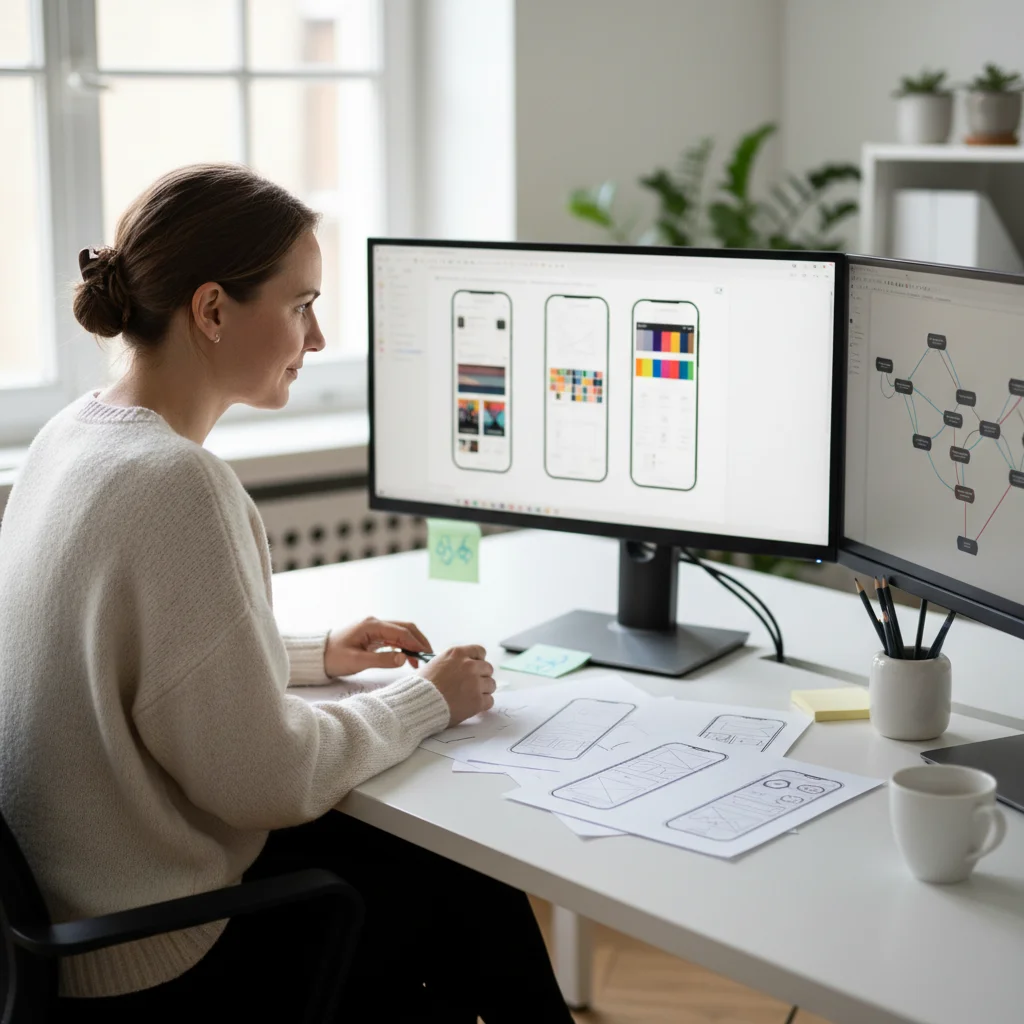
Based on the discovery, we create a technical design and, where useful, a working prototype. You see exactly what the solution will look like before we start building. Feedback at this stage saves time and money later.


Agile development & testing.
We build in short iterations so you can steer along the way. Every delivery is tested for functionality and quality. No surprises at the final handover.


Delivery & continuous improvement.
After go-live, we support you with maintenance, monitoring and ongoing development. Software is never finished, and it does not need to be. We ensure your solution stays relevant as your organisation grows.


Custom software with AI built in.
At Spartner, we combine years of software development experience with #MIND-white, our own AI platform. This means not only smarter software but also a faster development process. From automated document generation to intelligent workflows: we build AI in where it adds value, not as a buzzword.

Who is custom software suitable for?
Does this sound familiar?
Having software built to measure is not necessary for every organisation. But if you recognise any of these situations, it is worth considering: your team works around the limitations of your current software every day. You need integrations your standard package does not support. Your organisation is growing faster than your tooling can keep up. Or you face specific regulations that generic software does not cover.
What does custom software cost?
The cost of bespoke software depends on its complexity, the number of integrations and the desired functionality. We prefer an MVP approach: start small with core functionality, test with real users, and expand from there. This keeps the budget under control and prevents you from building features nobody uses. In an initial conversation, we give you a realistic estimate of scope and investment.

After delivery
Maintenance and continuous improvement
Software is not a one-off project. After delivery, we provide structured maintenance, security updates and technical monitoring. But we also think ahead about further development. Your organisation changes, your market changes, and your software needs to keep pace.
Ownership and control
At Spartner, the source code is always yours. No vendor lock-in, no dependency. You have full control over your software, your data and the direction of its development. For us, that goes without saying.

"A deal is a deal"
Yield.inc is a new asset manager in the Netherlands that focuses on excellent customer experience, sustainability and technology. When faced with the question of whether to develop our platform in-house or with a partner, we got in touch with Spartner. We are still 100% behind the choice for Spartner because we own the source code and with Spartner, a deal really is a deal, whether it concerns the delivery date or the agreed budget!
Hans Lugtenberg Partner at Yield Inc.

"A professional software partner since 2010"
Spartner is involved and contributes in our search for innovations and always delivers top-notch work. After the first Huurda.nl version got out-dated, we collaboratively launched a completely new version in 2020.
Custom-built search engine for rental propertiesNorbert Wegter Owner of 123wonen and Expat Homes Holland

"Pragmatic and flexible collaboration"
Spartner has created a customized portal for us for the accountability of large-scale collaborative projects. This enables us and our partners to execute and account for their plans in a shared environment that is secure, transparent, and manageable. The pragmatic and flexible collaboration with Spartner has ensured that we have quickly achieved a functional and user-friendly environment.
Jurjen Terpstra Managing Partner at Wecreate Consulting

"AI and machine learning as legal tools"
In 2020, we transferred the development of Lynn to Spartner. As a result of their fast development process, the Lynn platform achieves an increasingly central role in the legal world.
Lynn, the smart AI legal robotMarco Caspers Software Development Manager at Lynn Legal

"As a business you must dare to move forward"
Innovation and change are not always welcomed with equal enthusiasm by our employees, man is a creature of habit but as a company you have to dare to move forward and the need for a contemporary drawing program for the realization of various constructions with our Masterbloc bricks was high. For us but also for Spartner, this challenge was a bit of pioneering and together we had to overcome some hurdles to arrive at a beautiful and efficient business tool. A development and learning process for both parties, in which the feedback of questions and desired adjustments by our employees to Spartner was always in good consultation and we could count on quick feedback and targeted solutions. We continue to exchange experiences with Spartner and look back and forward to a successful collaboration.
Powerful 3D construction drawing softwareBjorn Gubbels Owner of Masterbloc

"Spartner extends our capabilities and development capacity"
With weekly calls, using our Azure DevOps sprint system, Spartner actively works together with our innovation, communication and software development departments.
Multi-website CMS with Statamic 3Marco Leenders Head of Automation

"Have been using Laravel Excel for years"
We requested custom help to a performance challenge we had in our implementation of Laravel Excel. I was amazed how quickly these Laravel artisans achieved significant performance gains, which saved us a lot of development time.
Open source package for LaravelJosh Mountain Co-Founder at IncentivePilot.com

"Higher occupancy rate thanks to our user-friendly platform"
Throughout the great years that we cooperate with Spartner (previously Maatwebsite, Ed.), our software has been developed continuously. Students and landlords actively work with features like allocation, payments, chat, contract generation and more.
Custom built ERP for all student residencesMaurice Evers Head of Student Housing Department
"Innovating in the digital identification network of The Netherlands and Europe"
The pro-active approach of Spartner was crucial in understanding the complexity of the eHerkenning network.
Development of eHerkenning connection and servicesMaarten Bremer CTO / Founder Ensured
.webp)
"Innovation in legal technology"
As jurists with knowledge of IT, we highly value quality; within code, but also in process. The high work-level and trustworthiness of Spartner gives us the capacity to continuously create innovative features.
Legal tech platformNiels Winters Managing Director JuriBlox
Frequently asked questions about custom software
Practical answers to the questions we hear most often about having software built to measure.
What is custom software and when do you need it?
Custom software is software developed specifically for your organisation's processes and requirements. You need it when standard software no longer suffices, for example due to limitations in integrations, reporting or scalability.
What is the difference between custom and standard software?
Standard software is designed for a broad market and offers generic functionality. Custom software is built around your specific way of working. You only pay for what you need, and the software adapts to you rather than the other way round.
What does it cost to have software built to measure?
Costs depend on complexity, the number of integrations and the desired functionality. We prefer starting with an MVP so you can build up the investment step by step. In an initial conversation, we provide a realistic estimate.
How long does it take to develop custom software?
That depends on the scope. A well-defined MVP can be ready within a few weeks. More complex projects take longer, but by working agile you receive working components along the way.
Can custom software be connected to my current systems?
Yes, that is precisely one of its biggest advantages. We build integrations with CRM systems, ERP packages, accounting software, HR systems and other tools you already use.
Who owns the software?
You do. The source code is yours and stays yours. There is no vendor lock-in. You can always have the software further developed, even by another party.
Can I start small with an MVP?
Absolutely. We even recommend it. Start with core functionality, test with real users, and expand from there. This prevents you from investing in features nobody uses.
What role does AI play in custom software development?
We use our own #MIND platform to build smarter software. Think of automated document processing, intelligent search functions or AI-driven workflows. AI is not a goal in itself, but a means to make your software more powerful. Curious where to begin? Visit our page on getting started with AI.
What happens after delivery?
We provide structured maintenance, security updates and technical monitoring. We also think ahead about further development: your organisation changes, and your software needs to keep pace.
Which sectors is custom software suitable for?
We build custom software for a wide range of sectors: fintech, legal tech, healthcare, real estate, industry, education and professional services. The solution is always tailored to your sector's specific requirements and regulations.