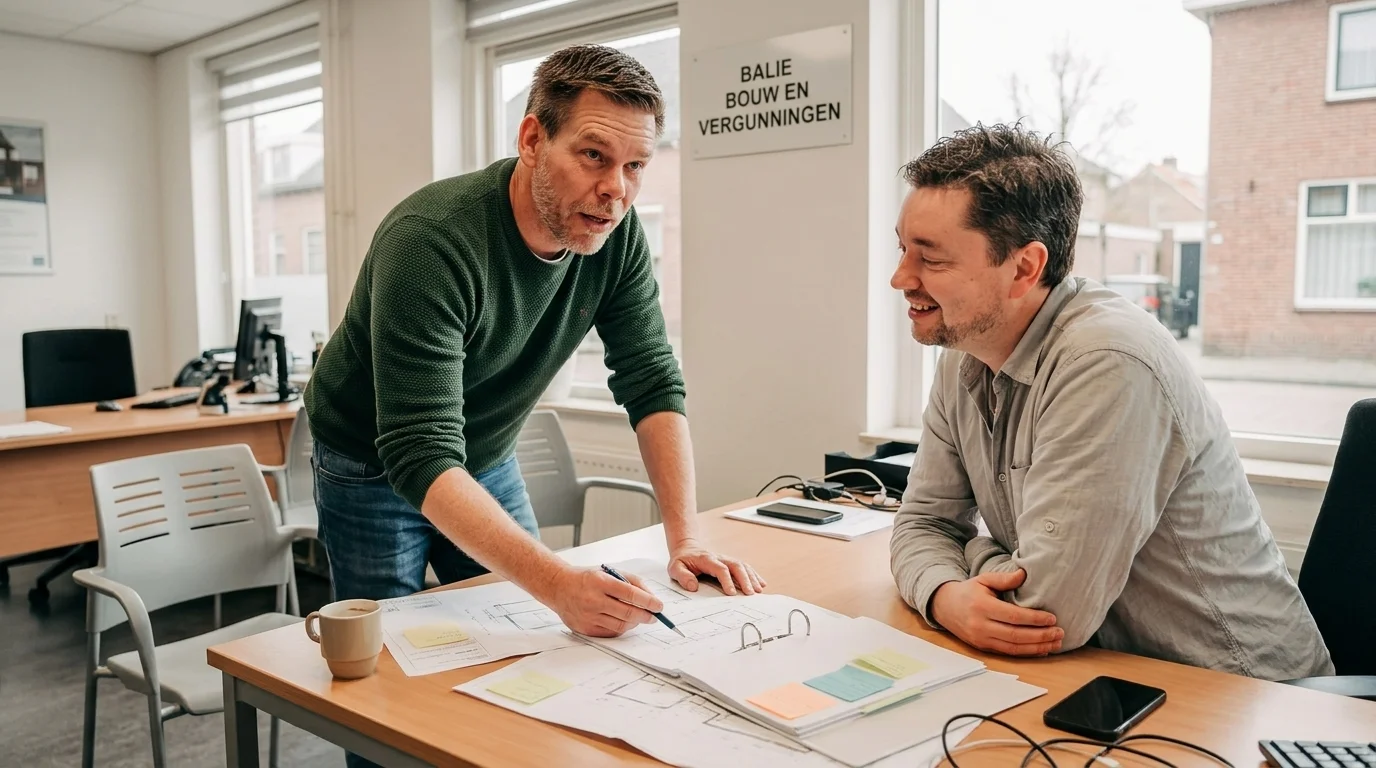
Smarter building,
faster permits.
Building plans gathering dust cost money and energy. With Spartner’s AI Building Permit Assistant you will discover within minutes whether your project is permit-free, which rules apply to your plot number and how your application can glide smoothly through the portal. Less guesswork, less frustration, just progress.
Why wait?
Building regulations are complex; our AI makes them clear.
Automate
Spartner links plot numbers to all relevant zoning plans, eliminating manual detective work so teams and architects alike can devote their time to design.
Integrate
The AI Building Permit Assistant communicates directly with PDOK databases, the Omgevingsloket and municipal back-office systems, so data never have to be entered twice.
Validate
During the conversation the chatbot checks every structure against the Building Decree 2012, local regulations and recent BOPA policy amendments, and suggests any missing attachments.
Collaborate
Initiator, advisor and municipality share one live dossier; everyone can see in real time which documents are still missing and which rules have been ticked off.

What it solves
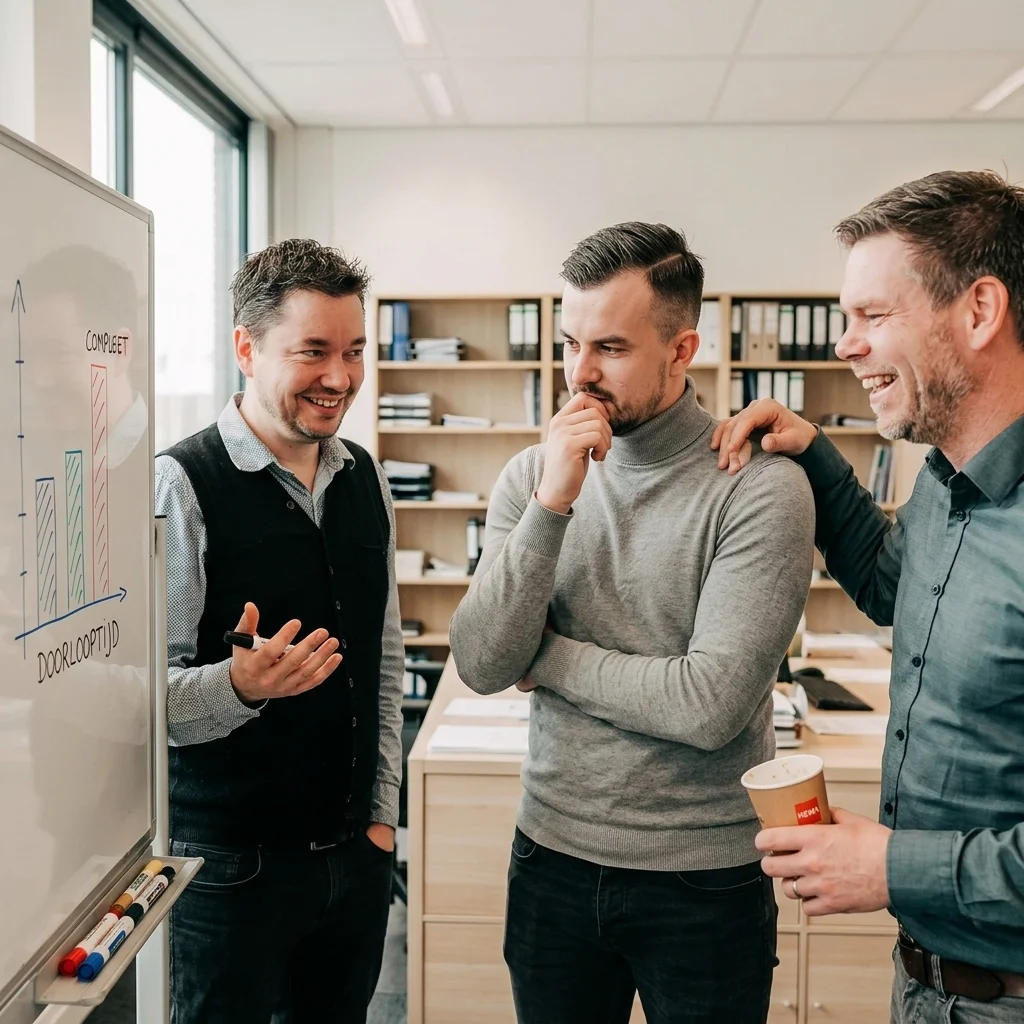
In recent years the average permit procedure has stretched to 13.4 weeks. We see in practice that as much as 40% of that is idle time caused by missing documents or misinterpreted regulations.
How it works
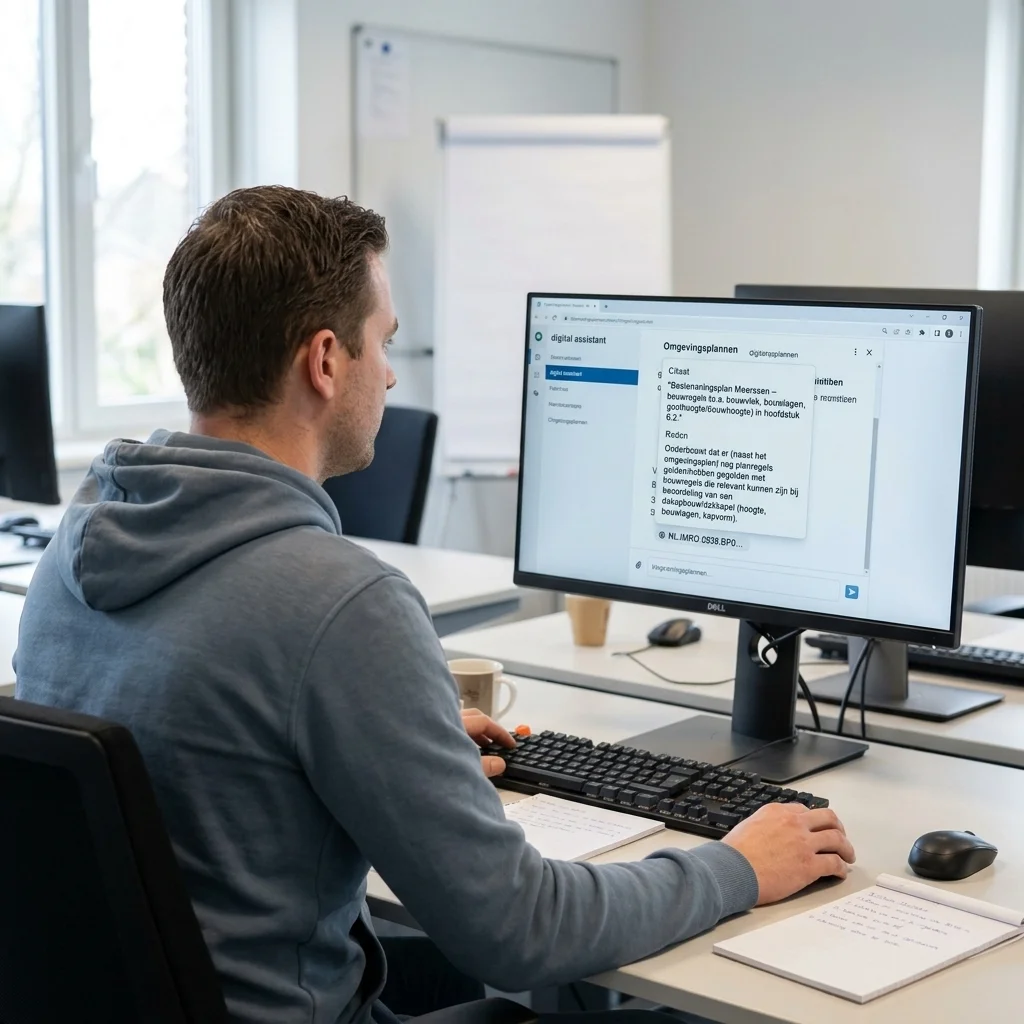
The assistant asks targeted questions, checks plot data with the Cadastre, receives instant feedback from the Omgevingsloket and highlights conflicts in plain language.
What we notice
Many applicants do not realise that a dormer window may be permit-free in one municipality while the identical dormer two streets away—just across a zoning boundary—requires a mandatory notification. Our AI does see that.
Less email back-and-forth, more building
Fewer fines due to incorrect notifications
More insight for investors before purchase
Less pressure on the municipal desk, fewer phone calls
How do you navigate this process?
A step-by-step approach that takes you from guesswork to a complete permit.
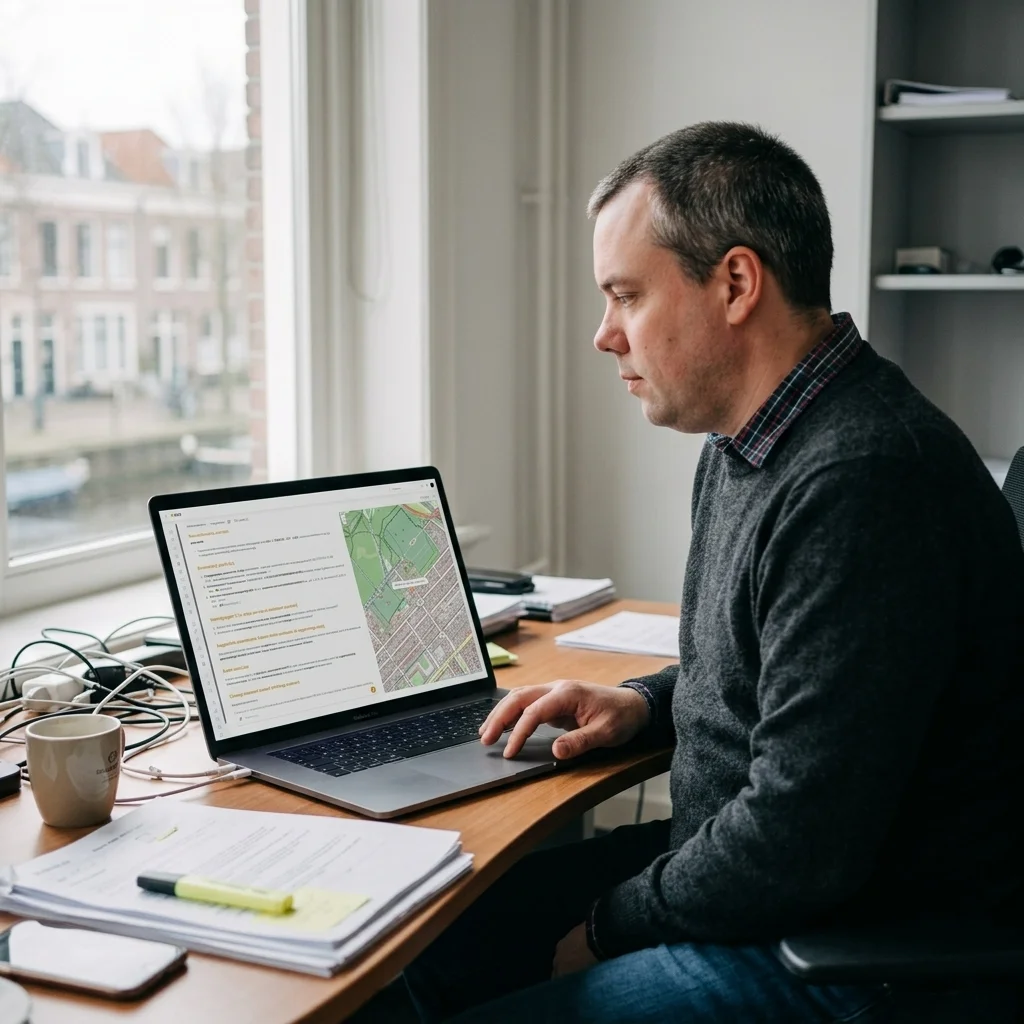

Step 1 – Inventory.
The initiator enters an address or plot number, uploads a sketch and describes the plan in their own words. The AI Building Permit Assistant interprets this using NLP, recognises functions (e.g. "rear extension 2.5 m") and automatically checks the applicable zoning plan.
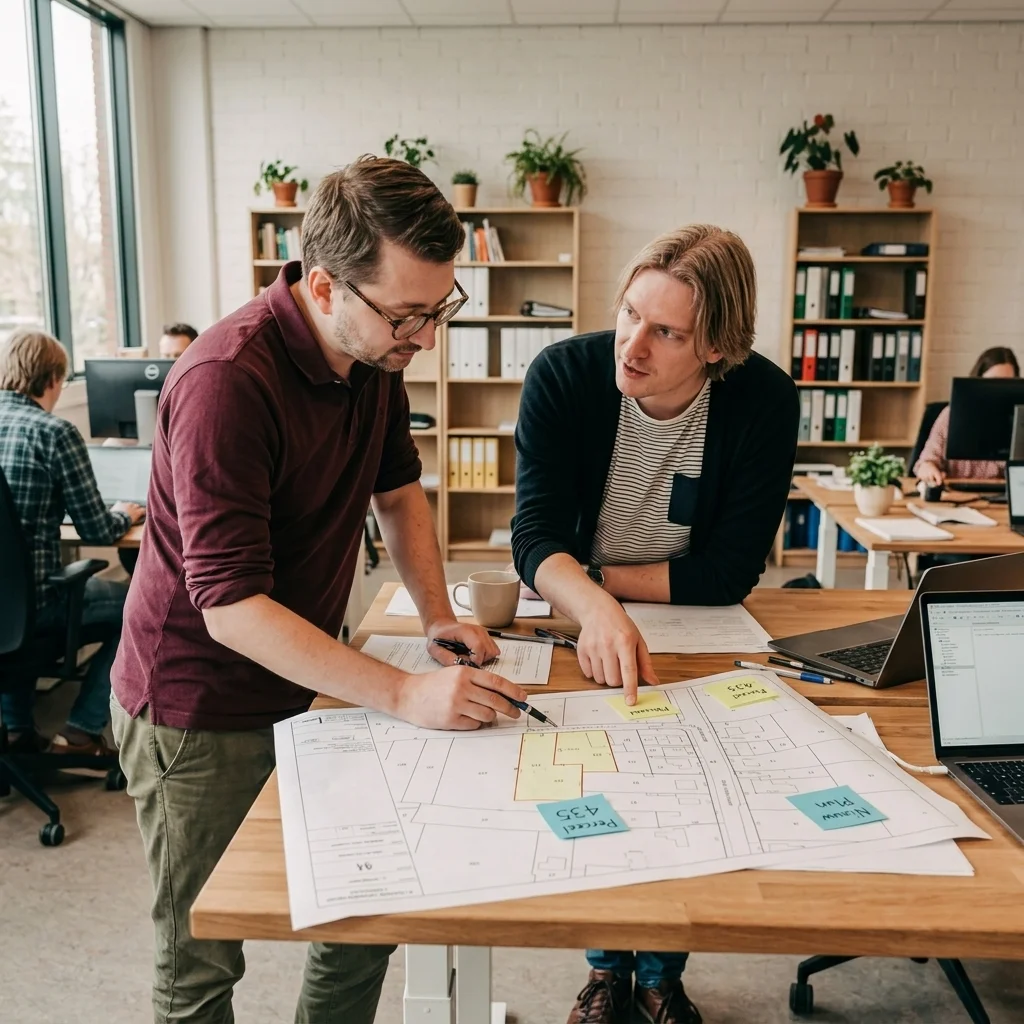

Step 2 – Dialogue & data fusion.
While the chatbot asks follow-up questions, it retrieves live data from PDOK, BAG, BGT and municipal regulations. Any Natura 2000 restrictions or aesthetic guidelines are incorporated immediately.
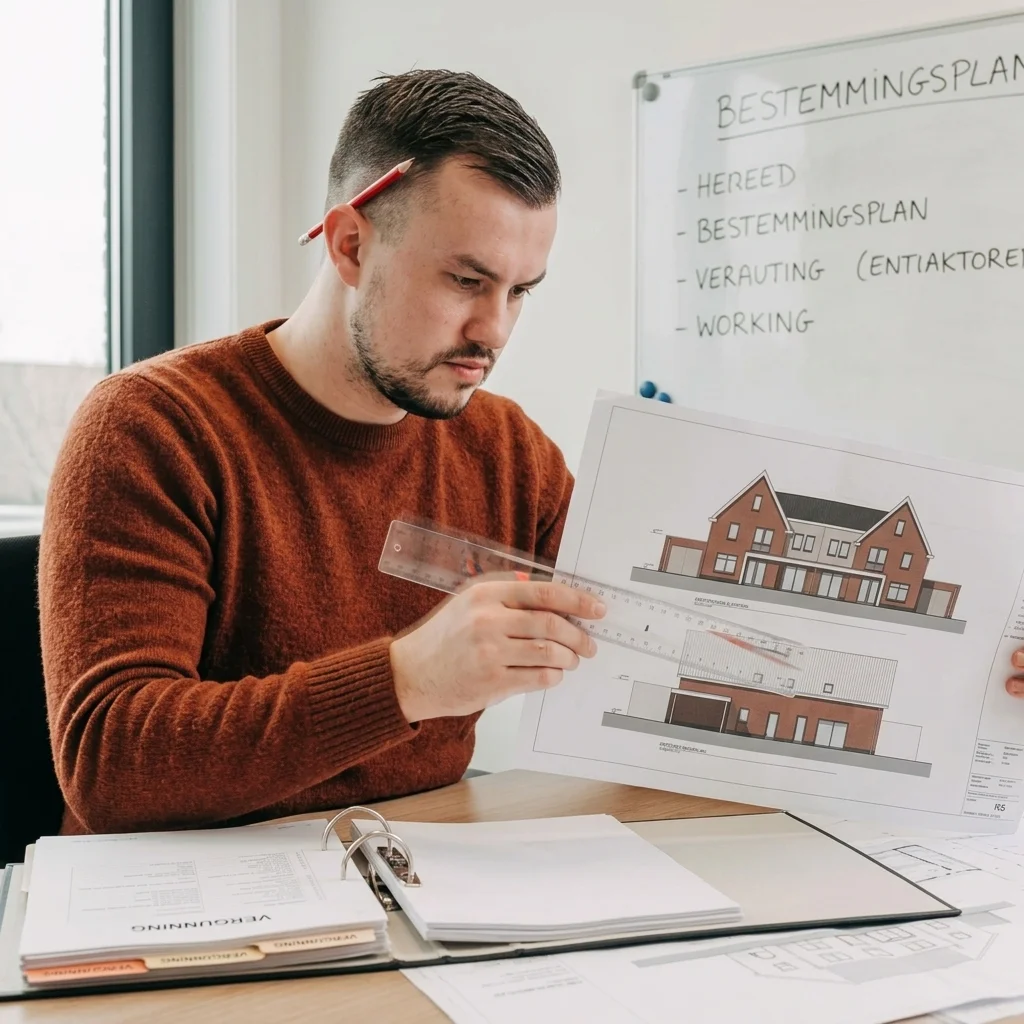

Step 3 – Rule check.
All case law and Building Decree articles are scanned. The tool compares dimensions, eaves height and cooling installations with the standards. Borderline cases are marked in yellow; hard rejections in red with explanation.


Step 4 – Optimise.
The user receives concrete alternatives: "Lower the ridge by 12 cm and the permit is likely to be granted immediately." In this way the AI moves from merely checking to actively thinking along—advice plus.


Step 5 – Submit.
With one click all completed fields are sent as a structured set to the Omgevingsloket and municipal case systems. Attachments are compressed and filenames automatically given the correct code.

Step 6 – Feedback loop.
After the decision we read back the ruling, train the model on new grounds for refusal and share anonymised insights with the municipality so future applications run even more smoothly.


Ready to cut the queues?
Have a chat with our team and discover how your organisation can be live with the AI Building Permit Assistant within four weeks. No strings attached—just a fresh coffee and a demo on your own project location.

A critical look at traditional workflows
For decades, municipalities and consultancies relied on static templates. Minutes, Excel columns and PDF checklists still drift across every server. The outcome is predictable: regulations change, versions go missing and nobody is sure whether the latest paragraph of the Building Decree has been processed. This leads to double entry, conflicting advice and unnecessary objections. The Spartner platform puts an end to this fragmented landscape by offering one single source of truth filled with continuously updated laws and regulations.
Local dynamics are the bottleneck
Legislation changes nationwide, but municipal policy rules often move even faster. A temporary aesthetic guideline or a pilot with tiny houses can turn policy upside down within a month. Our AI model monitors RSS feeds, council decisions and VNG publications so you never work with outdated information.
Municipalities already on board
The municipalities of Beverwijk, Apeldoorn and a joint environmental service in the Achterhoek already use the AI Building Permit Assistant in their daily assessments. In Beverwijk the average processing time for a standard plan has been reduced to eight weeks. Apeldoorn reports 23% fewer incomplete dossiers. The environmental service mainly benefits from the uniform motivation of refusals, which shortens objection procedures.
Learn together, improve together
By sharing feedback anonymously we create a collective learning environment. The AI sees, for example, that noise requirements near industrial estates are often misinterpreted. The model adapts the dialogue accordingly so future applications are clarified straight away.

A philosophical note: AI as the new urban planner
Cities have long been shaped by human intuition, political choices and—let’s be honest—financial interests. Now that an AI Building Permit Assistant is providing suggestions, a new player joins the table without emotion but with an ocean of data. Does this spell the end of spontaneous architecture, or does it actually create room for creativity because the parameters are clear? One could argue that the computer becomes the rational guardian while humans focus on aesthetics.
Ethics in code
What if the AI unintentionally harbours a bias against certain housing typologies? Transparency is therefore not optional but essential. At Spartner we publish the datasets used and log every decision so any advisor can zoom in on the basis of a refusal.

"A deal is a deal"
Yield.inc is a new asset manager in the Netherlands that focuses on excellent customer experience, sustainability and technology. When faced with the question of whether to develop our platform in-house or with a partner, we got in touch with Spartner. We are still 100% behind the choice for Spartner because we own the source code and with Spartner, a deal really is a deal, whether it concerns the delivery date or the agreed budget!
Hans Lugtenberg Partner at Yield Inc.

"A professional software partner since 2010"
Spartner is involved and contributes in our search for innovations and always delivers top-notch work. After the first Huurda.nl version got out-dated, we collaboratively launched a completely new version in 2020.
Custom-built search engine for rental propertiesNorbert Wegter Owner of 123wonen and Expat Homes Holland

"Pragmatic and flexible collaboration"
Spartner has created a customized portal for us for the accountability of large-scale collaborative projects. This enables us and our partners to execute and account for their plans in a shared environment that is secure, transparent, and manageable. The pragmatic and flexible collaboration with Spartner has ensured that we have quickly achieved a functional and user-friendly environment.
Jurjen Terpstra Managing Partner at Wecreate Consulting

"AI and machine learning as legal tools"
In 2020, we transferred the development of Lynn to Spartner. As a result of their fast development process, the Lynn platform achieves an increasingly central role in the legal world.
Lynn, the smart AI legal robotMarco Caspers Software Development Manager at Lynn Legal

"As a business you must dare to move forward"
Innovation and change are not always welcomed with equal enthusiasm by our employees, man is a creature of habit but as a company you have to dare to move forward and the need for a contemporary drawing program for the realization of various constructions with our Masterbloc bricks was high. For us but also for Spartner, this challenge was a bit of pioneering and together we had to overcome some hurdles to arrive at a beautiful and efficient business tool. A development and learning process for both parties, in which the feedback of questions and desired adjustments by our employees to Spartner was always in good consultation and we could count on quick feedback and targeted solutions. We continue to exchange experiences with Spartner and look back and forward to a successful collaboration.
Powerful 3D construction drawing softwareBjorn Gubbels Owner of Masterbloc

"Spartner extends our capabilities and development capacity"
With weekly calls, using our Azure DevOps sprint system, Spartner actively works together with our innovation, communication and software development departments.
Multi-website CMS with Statamic 3Marco Leenders Head of Automation

"Have been using Laravel Excel for years"
We requested custom help to a performance challenge we had in our implementation of Laravel Excel. I was amazed how quickly these Laravel artisans achieved significant performance gains, which saved us a lot of development time.
Open source package for LaravelJosh Mountain Co-Founder at IncentivePilot.com

"Higher occupancy rate thanks to our user-friendly platform"
Throughout the great years that we cooperate with Spartner (previously Maatwebsite, Ed.), our software has been developed continuously. Students and landlords actively work with features like allocation, payments, chat, contract generation and more.
Custom built ERP for all student residencesMaurice Evers Head of Student Housing Department

"Innovating in the digital identification network of The Netherlands and Europe"
The pro-active approach of Spartner was crucial in understanding the complexity of the eHerkenning network.
Development of eHerkenning connection and servicesMaarten Bremer CTO / Founder Ensured
.webp)
"Innovation in legal technology"
As jurists with knowledge of IT, we highly value quality; within code, but also in process. The high work-level and trustworthiness of Spartner gives us the capacity to continuously create innovative features.
Legal tech platformNiels Winters Managing Director JuriBlox
What makes the AI Building Permit Assistant different from the standard Permit Check? 🤔
The standard check in the Omgevingsloket works with static decision trees. Our assistant holds a dynamic conversation, recognises semantics in drawings and reads local policy rules, delivering tailored advice.
Is the tool legally binding? 📜
No, the final decision always rests with the competent authority. The assistant does help you interpret and substantiate all relevant articles correctly, increasing the chance of a positive ruling.
What about the privacy of drawings and personal data? 🔐
All data are processed within Dutch data centres. Personal data are stored separately; plans are anonymised after a decision so we can learn without tracing them back.
Can the municipality add or amend rules itself? 🏛️
Certainly. Policy officers have a visual editor to enter new articles or policy rules. The AI indexes them virtually in real time.
Does it work for listed buildings as well? 🏰
Yes. The platform fetches status information from the National Monuments Register and local heritage regulations. Expect stricter checks and extra questions about materials and appearance.
How much does it cost? 💸
We do not publish prices here. We can say that the hours saved and the reduction in failure costs usually more than offset the licence fee.
Which languages does the chatbot support? 🌐
Currently Dutch and English. German is on the roadmap because border regions increasingly request it.
Do I still have to call the desk as an architect? 📞
Usually not. We find that a dossier filled in properly via the AI is almost always complete at once. Yet personal contact remains possible and sometimes desirable.
How often is the legal database updated? 🔄
Daily. New council decisions are indexed within 24 hours so temporary policy changes are visible too.
Is it complicated to get started? 🚀
Not at all. Request an API key, connect to your case system, set roles and you are live. We guide the first pilot so you do not lose your way.