Definition and background
Prompt engineering is the systematic formulation, structuring and optimisation of textual and multimodal input for generative AI models, particularly large language models (LLMs). A prompt may consist of text, code, examples, metadata or other signals that steer the model. The essence of prompt engineering is that the way the instruction is phrased has a directly measurable impact on the quality, consistency and safety of the model's output.
Large language models, such as recent generations of GPT, Claude, Gemini, Grok and a range of open-source models, are trained on vast amounts of text data. During training these models learn probability distributions over words and sentences, but they do not 'understand' prompts as humans do. Instead, they respond to statistical patterns. Prompt engineering attempts to exploit and guide those patterns so that the model's response better matches the user's intent.
In practice the term prompt engineering is used for everything from simple prompt tips for end users to advanced techniques applied by AI engineers, researchers and software developers. The field has rapidly evolved from a pragmatic art form into a more systematic discipline, with research literature, best practices and evaluation methods.
Purpose and scope
The primary goal of prompt engineering is to increase the effectiveness of generative AI in concrete applications, including text generation, question answering, summarisation, code generation, data extraction, translation, creative content and reasoning tasks. By choosing the right prompt structure, various properties of the output can be influenced, such as accuracy, tone, length, style, creativity, safety and robustness.
The scope of prompt engineering spans multiple modalities. In addition to text, prompts are increasingly combined with images, audio, video or structured data. Multimodal models can, for example, receive a text prompt and an image at the same time, with prompt engineering determining how that combination is supplied and interpreted. In voice-driven systems the text prompt is often automatically derived from speech-to-text, with the prompt engineer adding extra system instructions that guide the interaction.
Prompt engineering does not stand alone but is linked to other disciplines such as model architecture, fine-tuning, retrieval-augmented generation (RAG), system design and evaluation. In production environments prompt engineering is usually combined with programmatic control layers, logging and monitoring to ensure consistent behaviour.
Key concepts and building blocks
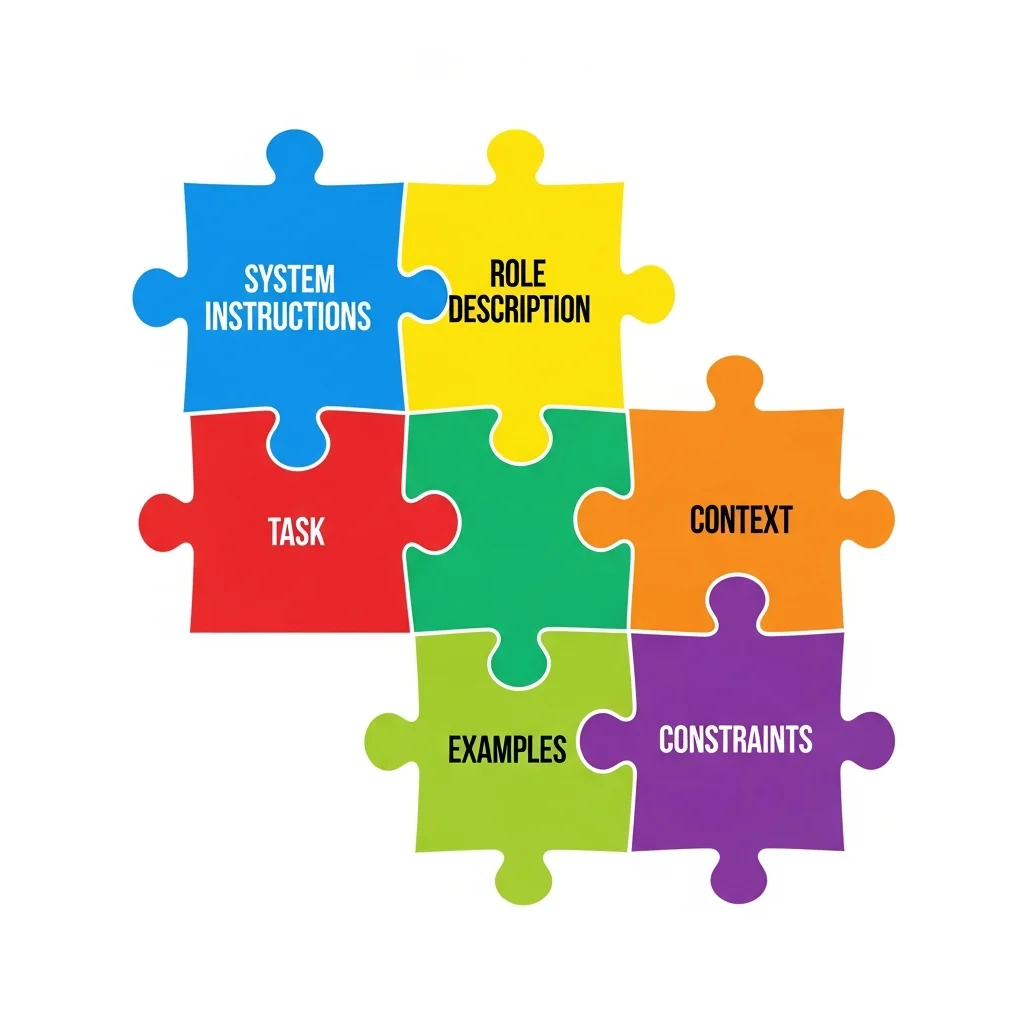
A modern prompt often consists of several components that together determine the model's behaviour. Common building blocks are system instructions, role descriptions, task descriptions, context, examples and constraints. By structuring these elements explicitly, the prompt engineer can clearly specify the intent and boundaries.
System instructions describe at a high level what the model is and how it should behave, for instance that it acts as a technical documentation system or a legal summarisation assistant. Role descriptions state the perspective from which the model should reply, such as an experienced software developer, teacher or help-desk agent. Task descriptions specify the concrete assignment, for example 'summarise', 'generate code' or 'analyse'.
Context is all additional information the model needs to perform the task, such as document texts, user questions, data from an external source or previous messages in a conversation. Examples, often in the form of so-called few-shot prompts, explicitly show what correct input and desired output look like. Constraints capture what the model may and may not do, for example limits on length, language, style, safety or factual claims.
Main techniques
Prompt engineering comprises a set of recurring techniques that are widely applied in research and practice. The first category is instruction-based prompts, in which the assignment is formulated explicitly and in a structured way, for instance with clear steps or criteria. This prompt type has in many cases replaced the earlier, more implicit questioning style.
The second category is example-driven prompts. In few-shot prompting a handful of input-output pairs are provided so that the model can infer the pattern and apply it to new input. In in-context learning the model uses these examples as temporary training within a single prompt, without the model's weights being changed.
The third category consists of chain and decomposition techniques. Chain-of-thought prompting explicitly asks the model to describe intermediate steps for reasoning tasks, which can improve accuracy on complex problems. Variations include 'let's think step by step' patterns, structured reasoning formats and splitting a task into multiple focused prompts executed sequentially.
The fourth category focuses on role-based prompts. By explicitly positioning a model as a certain expert role or persona, answers often become more consistent and better tailored to the target audience. Modern models also support so-called tool or function calling, in which prompt engineering defines the specific schemas and instructions that allow the model to call external functions, APIs or data sources.

Evaluation and optimisation
Effective prompt engineering requires systematic evaluation. Instead of trial and error with single prompts, structured experimentation processes are increasingly used. This includes defining test sets, recording quality criteria and automatically comparing different prompt variants. Measurements can be quantitative or qualitative, for example by using scoring models or human reviewers.
An important consideration is generalisation. A prompt that works well for one example must also be robust across a broad range of inputs, including edge cases. To achieve this, prompts are tested on variation in language, context length, erroneous input and adversarial examples. Prompt engineers therefore look not only at average performance but also at spread and worst-case behaviour.
Maintenance also plays a role. As models are updated, existing prompts may perform differently. Professional environments therefore employ version control, monitoring and recalibration. Prompt variants are stored, documented and, where possible, automatically adjusted based on performance data.
Relationship with other AI techniques
Prompt engineering is closely connected to other techniques within the generative AI landscape. During fine-tuning the model weights are adapted to domain-specific data, whereas prompt engineering steers the existing model via input. In many applications both are combined: a generic model is first refined for a particular task and then driven with carefully designed prompts.
In retrieval-augmented generation, prompt engineering plays a central role in linking search results or documents to the model. The prompt determines how retrieved context is presented, how the model is instructed to use only that context, and how sources are incorporated in the output. This is crucial for reducing hallucinations and improving factual grounding in knowledge-intensive tasks.
Prompting is also important in agent systems, where an LLM autonomously plans sub-tasks, calls tools and executes multi-step plans. The so-called system prompt defines the agent's general behaviour rules, the available tools and how intermediate results are interpreted. Sub-prompts guide the agent while planning, evaluating and adjusting actions in iterative loops.
Safety, ethics and limitations
Prompt engineering directly touches on questions of safety and ethics. The way a prompt is phrased can influence the risk of inappropriate content, discrimination or misinformation. Safety guidelines and content filters are therefore often combined with carefully crafted prompts that prevent or neutralise risky instructions.
One well-known limitation is that prompts never provide full control over model behaviour. LLMs remain probabilistic systems that can hallucinate, make incorrect assumptions or misinterpret context. Prompt engineering can reduce the likelihood of errors but cannot eliminate them completely. Nor is there any guarantee that a prompt which works well on one model or model version will perform equally well on another.
There are also questions about transparency and reproducibility. Because prompts can contain complex instructions and are sometimes trade secrets, it is not always easy to reconstruct, after the fact, the decisions influenced by AI systems. This is relevant for heavily regulated sectors such as healthcare, finance and legal services, where audit trails and explainability are important.
Applications in software development and business processes
In software development, prompt engineering is used for code generation, refactoring, test generation, documentation and code review. By using specific prompt patterns, such as providing existing code fragments, project conventions and desired output formats, developers can better steer the output of code assistants. This reduces the chance of syntactic errors and inconsistencies and can boost productivity.
Within organisations prompt engineering is applied across a wide range of business processes. Examples include customer service, knowledge management, marketing, legal analysis, compliance support and internal document automation. In such contexts prompts are often wrapped in fixed templates or workflows so that end users do not need to craft prompts themselves but supply information via forms, buttons or fields.
Platforms that deploy AI as middleware, such as custom AI layers on top of CRM, ERP or content management systems, use prompt engineering to consistently inject business context, policy and tone of voice. This makes it possible to combine the generic capacity of LLMs with organisation-specific rules and knowledge without retraining new models for every change.
Example structure of a prompt
The simplified prompt below illustrates how different components can be combined in a single instruction. It is not a normative format, but rather a common pattern in practical environments.
System role:
You are a technical knowledge-base article generator that provides neutral, factual explanations in Dutch at B1-B2 level.
Task description:
Explain the concept "prompt engineering" in 800 to 1,000 words, including definition, key techniques, applications and limitations.
Context:
The reader is a technically-skilled professional with experience in software development or data, but new to generative AI.
Style and safety rules:
- Do not use personal anecdotes.
- Avoid irrelevant details and speculation.
- Correct implicit misconceptions where necessary.
- Do not use confidential or identifying data.
Output:
Generate structured text with clear section headings and short paragraphs.
This example shows that a prompt can consist of several sections, each with its own function. Applying this structure consistently can increase the reliability and predictability of LLM-based systems.
Relationship with training and best practices
Prompt engineering has become a recurring topic in courses, workshops and internal training programmes. Instead of ad-hoc use of generative AI, users are trained in basic principles such as phrasing clearly, providing explicit context, refining iteratively and critically assessing results. This helps organisations to apply generative AI more safely, efficiently and consistently.
Best practices include avoiding vague instructions, specifying output formats, including sample answers, stating assumptions and explicitly asking for source references or uncertainty indicators where relevant. It is also recommended to document prompts and reuse them as 'prompt templates', so that knowledge is not scattered across individual users but remains available to teams and organisations.
Although prompt engineering is a relatively young discipline, it is rapidly moving towards greater systematisation, with research, tooling and standards. Prompt engineering is expected to remain important for as long as generative AI models use text and other signals as their main interface, and it will be an essential part of the design and management of AI-supported information systems.